So today I needed to do something completely different (without pulling any of John Cleese's faces). My dissertation-writing motivation has come to a grinding halt and I didn't feel up to any painting or re-discovering my knitting abilities.
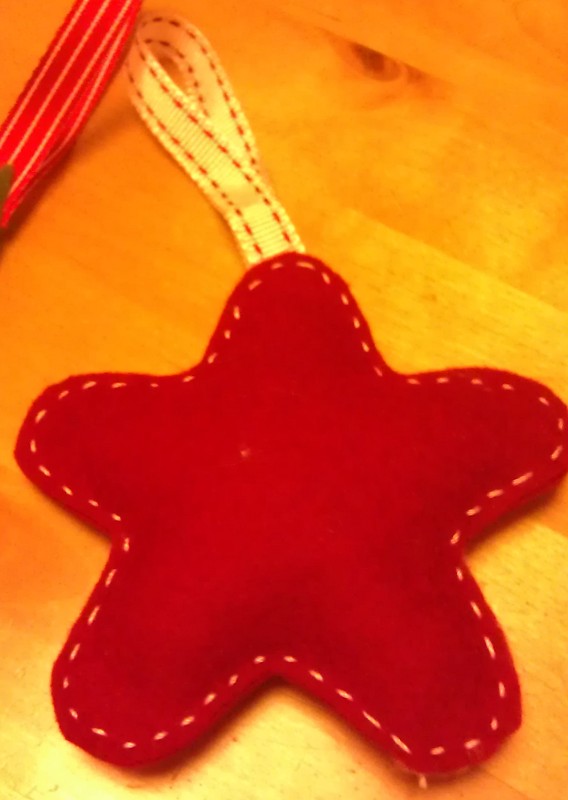
So I made some felt Christmas ornaments.
I got the idea for these while browsing the IKEA Christmas page (they have some really really nice glass ornaments with spirals which I am definitely getting if we can fit a big tree somewhere), when I saw these cute felt Christmas trees. Nice! I thought. I can make those myself! I thought.
So I did.
And then, because just one ornament isn't enough, I made a star (which looks more like a flower, but hey):
I'd like to have made one of the bell shaped ones as well, but I only had white thread and I'd like the thread to contrast with the felt, so that will be for later (I'll probably stitch that one over the side, rather than following the contours, just to see how it looks). And more stars and trees, of course, the hypothetical future tree will be well-filled.
Please do note that I managed to get the ribbon on lopsided on both of them, even with fastening it to the felt before stitching it shut. I never said I was good at sewing, I'm just a time-for-something-different-and-relaxing sewer!
Random thoughts, creative inspiration, culinary outbursts, and the written word.
Tuesday, 23 October 2012
Sunday, 21 October 2012
Autumn colours
I love autumn colours. I may have mentioned this before, and it is something that is usually on the back of my mind throughout the year, but when they actually arrive in full force, I can't help but be amazed at how much I love them.
Yesterday we drove to the zoo in my hometown and there were stretches of road that were completely orange or red or yellow, or a beautiful combination of them all. When we were in the US I was dying to see some famous "fall foliage" and I'm really sad that we missed it, but now that I see the stuff around here I'm wondering if it was always this good and I have just been missing what was right in front of me all those years? Surely, the world was never this pretty and warm-coloured and showering leafs down by the bucket load?
Sadly, they're usually gone within the week. Also, because of some weird warm weather we've been having lately, some trees are still enthusiastically and brightly green, while others are completely bare already. Again, not sure if this happens every year, but it struck me.
It's one of those things where I go "ooh, that's pretty" and then not take a photograph or make myself look better, thinking that it will still be there the next time I'm around, but it never is, and I always feel sad about missing it, or not really seeing it. But that's how it goes, I guess, even though most people now do take pictures and put everything on Facebook for the whole world to see and remember, I'm sure many young parents today will still go "they grow up so fast! It feels like they were still babies yesterday!" when their kids go off to live on their own.
And in a way it's good you can't remember everything, or your head would explode.
Anyway, even though I haven't been taking pictures myself, I've been asking for autumn colours on Postcrossing, and I got some especially nice ones that I can't help but share with you. They're from around the world, although of course pretty much restricted to the northern hemisphere (one of the reasons I'd never move to Australia, I don't think I'd be able to survive without a proper autumn).
ETA: oops, nearly forgot this one, which shows beautiful Lapland:
(I have more general forest/forest path cards too, which I think are lovely and magical and beautiful in their own way, but I'll save those for another day.)
Yesterday we drove to the zoo in my hometown and there were stretches of road that were completely orange or red or yellow, or a beautiful combination of them all. When we were in the US I was dying to see some famous "fall foliage" and I'm really sad that we missed it, but now that I see the stuff around here I'm wondering if it was always this good and I have just been missing what was right in front of me all those years? Surely, the world was never this pretty and warm-coloured and showering leafs down by the bucket load?
Sadly, they're usually gone within the week. Also, because of some weird warm weather we've been having lately, some trees are still enthusiastically and brightly green, while others are completely bare already. Again, not sure if this happens every year, but it struck me.
It's one of those things where I go "ooh, that's pretty" and then not take a photograph or make myself look better, thinking that it will still be there the next time I'm around, but it never is, and I always feel sad about missing it, or not really seeing it. But that's how it goes, I guess, even though most people now do take pictures and put everything on Facebook for the whole world to see and remember, I'm sure many young parents today will still go "they grow up so fast! It feels like they were still babies yesterday!" when their kids go off to live on their own.
And in a way it's good you can't remember everything, or your head would explode.
Anyway, even though I haven't been taking pictures myself, I've been asking for autumn colours on Postcrossing, and I got some especially nice ones that I can't help but share with you. They're from around the world, although of course pretty much restricted to the northern hemisphere (one of the reasons I'd never move to Australia, I don't think I'd be able to survive without a proper autumn).
| US-1895607 received 9 October 2012 |
| FI-1562808 received 15 October 2012 |
| JP-319569 received 15 October 2012 |
| FI-1552323 received 4 October 2012 |
Labels:
nature,
Postcrossing,
random thoughts
Location:
Groningen, The Netherlands
Monday, 15 October 2012
Space connections
So yesterday I watched Felix Baumgartner jump from his balloon back to Earth. I wasn't alone in doing this, apparently 8 million people were watching the live YouTube stream at the time of his jump. Now apart from the fact that I wouldn't even be able to blink my eyes if I knew 8 million others were watching me do it, I think this really shows how information and the sharing of information has taken a giant leap forward in the past few years. 5 years ago, nobody could have imagined something like this being streamed on the Internet for that many people to watch. Information has become available to all in so many ways, it is almost impossible to keep up. I know a lot of people are angry at Facebook and Google because of their 'share everything' policy, as it sends your information to advertisers. But in general, the principle is undoubtedly very good. Also, I think it shows how humans all over the world are inherently similar in so many ways, which will do even more to connect people and possibly work against future misunderstandings, discrimination, and wars.
Yes, I know, I'm both an optimist and a pacifist.
In other space news today, there is a Dutch company, Mars One, aiming to settle the first human settlement on Mars around 2023. Not for any lofty scientific purposes, no, they want to make a reality series out of it. The audience would be able to select which group of settlers is allowed to go first, and then follow their every move. Voting people off would be a bit difficult, as once they land on Mars, they won't be able to ever go back again. This means that those crazy enough to go (they appear to have 1,000 applications already) will be stuck on Mars for the rest of their lives. And those lives will be streamed back to Earth 24 hours a day, for as long as they all shall live.
I am unsure what to think of this. I am uninterested in reality series personally, but not against them per se if the people participating are aware of what they are doing and have fully agreed to it. It is another side of the 'information free for all' I just mentioned. However, I do think the exploration of another planet may be a bit too serious to throw into a reality tv format. Then again, sponsoring and actually achieving the goal (a human settlement on Mars) may be easier to achieve this way than through academic/scientific missions, and if we have to choose between no exploration or exploration through commercial means, then the latter is probably the better option. Still, it feels different than watching Felix make his record jump, even if in principle, it is the same thing...
Yes, I know, I'm both an optimist and a pacifist.
In other space news today, there is a Dutch company, Mars One, aiming to settle the first human settlement on Mars around 2023. Not for any lofty scientific purposes, no, they want to make a reality series out of it. The audience would be able to select which group of settlers is allowed to go first, and then follow their every move. Voting people off would be a bit difficult, as once they land on Mars, they won't be able to ever go back again. This means that those crazy enough to go (they appear to have 1,000 applications already) will be stuck on Mars for the rest of their lives. And those lives will be streamed back to Earth 24 hours a day, for as long as they all shall live.
I am unsure what to think of this. I am uninterested in reality series personally, but not against them per se if the people participating are aware of what they are doing and have fully agreed to it. It is another side of the 'information free for all' I just mentioned. However, I do think the exploration of another planet may be a bit too serious to throw into a reality tv format. Then again, sponsoring and actually achieving the goal (a human settlement on Mars) may be easier to achieve this way than through academic/scientific missions, and if we have to choose between no exploration or exploration through commercial means, then the latter is probably the better option. Still, it feels different than watching Felix make his record jump, even if in principle, it is the same thing...
Labels:
random thoughts,
science
Location:
Groningen, the Netherlands
Friday, 12 October 2012
Postcards revisited
It's been a while since I told you about the great postcards I'm receiving, so I thought I'd do a bit of a 'revisited' post, where I can highlight new editions to categories I've already posted about.
These include (linking back to the original posts for those who missed them):
To start with the first one, I have received some truly magnificent Alice in Wonderland cards over the past few months.
A really really old and really really worn (and dirty!) Alice postcard from Russia. My guess is that this thing is actually around 60 years old, and that the sender picked it up second-hand somewhere. It says "Alice in Wonderland" in Russian on the back.
Not sure what to make of these two, the first one looks a bit dollish and the second one a bit messy, really. I've also received another card from the series I was so happy about in my original Alice in Wonderland post:
I have received so many arty cards (Monet, Renoir, Van Gogh...) I could never show them all to you, so I will stick to the really interesting ones:
This card was send to me by a German baby (more likely, his mother) who profoundly excused himself for not having a 'proper' card. I think this is one of the most beautiful cards I've received, it shows a collage from an art exhibition in Bremen.
I love cats, I love poppies, I love the style of this artist, I love all her work.
Sadly enough, no more street art cards, but then the Samuel Beckett one will be hard to beat anyway.
In home-made cards, I've received several photographs-turned-postcard, and one creative actual postcard made by an art student that shows the sender:
but the absolute winner is this one:
It's made of various colourful circles which really give the card some texture, I can't imagine how much work went into making it!
Finally I've received several more Beatrix Potter cards, some duplicates, and one I really like:
basically because Benjamin Bunny is my favourite Potter character (tied with Tom Kitten).
So in contrast to what you might be thinking after my long silence on the topic, my Postcrossing is still going very strong! And these are just a couple of the categories I collect, there's also forests (including autumn colours), books and book covers, poems, cats, owls and other birds, special weather (lightning, the Northern Lights), baking, and of course, tea! Have a look in my received gallery if you've become curious (or jealous :p)!
These include (linking back to the original posts for those who missed them):
To start with the first one, I have received some truly magnificent Alice in Wonderland cards over the past few months.
| RU-1039418 received 4 July 2012 |
| UA-322450 received 20 August 2012 |
| RU-1206945 received 29 September 2012 |
Not sure what to make of these two, the first one looks a bit dollish and the second one a bit messy, really. I've also received another card from the series I was so happy about in my original Alice in Wonderland post:
| HK-85992 received 8 October 2012 |
I have received so many arty cards (Monet, Renoir, Van Gogh...) I could never show them all to you, so I will stick to the really interesting ones:
| DE-12216081 received 1 February 2012 |
| RU-77975317 received February 2012 |
Sadly enough, no more street art cards, but then the Samuel Beckett one will be hard to beat anyway.
In home-made cards, I've received several photographs-turned-postcard, and one creative actual postcard made by an art student that shows the sender:
| CN-523820 received 8 February 2012 |
| US-1704636 received 12 June 2012 |
Finally I've received several more Beatrix Potter cards, some duplicates, and one I really like:
| JP-311676 received 25 September 2012 |
So in contrast to what you might be thinking after my long silence on the topic, my Postcrossing is still going very strong! And these are just a couple of the categories I collect, there's also forests (including autumn colours), books and book covers, poems, cats, owls and other birds, special weather (lightning, the Northern Lights), baking, and of course, tea! Have a look in my received gallery if you've become curious (or jealous :p)!
Monday, 8 October 2012
NaNoWri-NO!
Autumn has really arrived. Last Friday we had a full-blown autumn gale which threw all the chestnuts from my parents' chestnut tree and left many people wandering around with broken umbrellas. Now the atmosphere has settled again, no rain, no clouds, and the clear sky brings very cold nights and chilly but extremely fresh mornings. I love the crisp smell of autumn, maybe even more than the warm tinge that announces summer in May. For me, this holds the promise of enjoyment to come: my birthday, Sint Maarten, Sinterklaas, Christmas, all those bright and warm and happy gatherings.
Also, this air gets my creative juices flowing. Normally, I would be preparing for NaNoWriMo, the National Novel Writing Month, by thinking up a plot and protagonist while translating their webpages into Dutch. But this year, I'm doing neither. I can barely keep everything together as it is, between my internship and dissertation and social life and committees and what not, so writing 50,000 words of prose is completely out of the question.
It's the first time in 6 years that I won't be competing. The first few years I failed, but I won (which means: I wrote a novel of at least 50,000 words within a month) in 2009, 2010 and 2011. I can't even remember what those novels were about, to be honest, but that's not the point, the point is to write write write until you can't write anymore.
But not for me, this year.
I'd fully resigned to this, and even sent them an e-mail stating that I wouldn't do the translation this year, but be back next year (in which I told them I was 'doing an intern' rather than 'doing an internSHIP', which must have caused some hilarity...), when people on Facebook who've never shown any literary ambitions before suddenly started posting "doing NaNo this year! First time!" and I started receiving emails from the Write-In group that I attend here in Groningen asking when we will first meet up, and stuff about the launch party and what not, and now I feel like I'm missing out on this really big and beautiful thing and I should try and do it anyway. And it's true, I am missing out on a great thing, but really, it's more the atmosphere of connectedness and striving together to reach this great, impossible goal that I'll miss, not the frustration and hard work and cold fingers and jealousy at those who finish within 24 hours while you haven't even started etc etc. But those are the things you forget, while the great people and great moments and great feeling when you've finished stay with you.
So for those who are not swamped with work this November, and feel like they could write a novel, or could be the sort of person who writes novels, or just want to join an amazing community that inspires people around the world: www.nanowrimo.org.
Next year, I'll be back.
Also, this air gets my creative juices flowing. Normally, I would be preparing for NaNoWriMo, the National Novel Writing Month, by thinking up a plot and protagonist while translating their webpages into Dutch. But this year, I'm doing neither. I can barely keep everything together as it is, between my internship and dissertation and social life and committees and what not, so writing 50,000 words of prose is completely out of the question.
It's the first time in 6 years that I won't be competing. The first few years I failed, but I won (which means: I wrote a novel of at least 50,000 words within a month) in 2009, 2010 and 2011. I can't even remember what those novels were about, to be honest, but that's not the point, the point is to write write write until you can't write anymore.
But not for me, this year.
I'd fully resigned to this, and even sent them an e-mail stating that I wouldn't do the translation this year, but be back next year (in which I told them I was 'doing an intern' rather than 'doing an internSHIP', which must have caused some hilarity...), when people on Facebook who've never shown any literary ambitions before suddenly started posting "doing NaNo this year! First time!" and I started receiving emails from the Write-In group that I attend here in Groningen asking when we will first meet up, and stuff about the launch party and what not, and now I feel like I'm missing out on this really big and beautiful thing and I should try and do it anyway. And it's true, I am missing out on a great thing, but really, it's more the atmosphere of connectedness and striving together to reach this great, impossible goal that I'll miss, not the frustration and hard work and cold fingers and jealousy at those who finish within 24 hours while you haven't even started etc etc. But those are the things you forget, while the great people and great moments and great feeling when you've finished stay with you.
So for those who are not swamped with work this November, and feel like they could write a novel, or could be the sort of person who writes novels, or just want to join an amazing community that inspires people around the world: www.nanowrimo.org.
Next year, I'll be back.
Location:
Groningen, the Netherlands
Tuesday, 2 October 2012
A Writing Rush
So apart from the internship (which I will not say much about apart from that it took some time to get used to working in an office with a lot of other people around me after working at home for so long, but which is going very well and which I am enjoying immensely) I am also writing my MA dissertation. This is the final big piece of independent research I am required to do before I can graduate, and it has to be about 15,000 words. I'd known since last year, when I took a course on the subject, that I wanted to write about Jane Austen, and already arranged my proposal and background chapter before going to the US.
But then, when I came back, the struggle began. How to start. I think this is the biggest problem most people who have to do a really big assignment that will span several months face, and for me, it was no different. I was planning to start the Friday after we came back, but no, to much other stuff to do; the Monday then, no, to many appointments; the Tuesday, no, then I had a meeting with supervisor and could still put it off until finally, last Friday, I actually started writing. This feels like it was weeks ago, so I am surprised to think that I've only been officially writing for 5 days. By that time, mind you, I was completely freaking out, already behind on my own schedule by 2 weeks, and convinced I would never finish the thing.
I know a lot of people are freaking out about their dissertations right now, as it is already October and we have to be done before February, but as usual, I should not have bothered. About an hour ago, I finished my first chapter. It's 2,500 words, it compares the two novels I wanted to use in depth, using 3 primary and 8 secondary sources. I have no idea how I do this, but somehow, whenever I start writing, things just work. I get into this zone of writing, which usually lasts about 3 hours, and at the other end I'm halfway there. Add another day like that and most of the chapter is there, and then a final day to make some changes, put in some extra footnotes, and check the last things, and done.
This does not mean that the chapter is 100% done, of course, I could keep adding more onto it until my entire dissertation consists of just this chapter (which I won't do, obviously, unless my supervisor wants me to add something), I still have to re-read it to see if I don't want to change any sentences (I haven't even spell-checked it) and also, once my supervisor has looked at it she may well ask me to rewrite the whole thing. But most of it is there. Again, I have no idea how I do this or why this works for me. It's highly efficient, as I'm done after only a couple of hours work each day, but this somehow bothers me and I keep sitting behind my computer thinking up all the things I could be doing (right now, I'm already writing stuff for the second chapter, the easy bits which don't need that much thinking over) just because I feel like I should be doing more. I know some people are jealous of me because it seems to come so easily, but they may be forgetting that I'd already read 15 books on this subject (plus the 6 novels I'm using) before I started writing, and that I've been thinking about this stuff for 3 months now. So it's not that strange that things easily form connections and make sense in my head, but also, it's not as if it's effortless, because I am completely drained after a day's work.
Still, it feels like I should be doing more, as if it's coming too easy to me, as if what I've written can never be good enough. Over the years, I've tried to ignore that voice and just handed things in a week before the deadline only to stop myself from fidgeting about it when it was really done. I think I should do the same with my dissertation, even though it feels really weird to stop working before 15:00 when you still have so much to do. But if I can do that amount in a really short time period, maybe I should start enjoying all the time that is left over a bit more, instead of worrying. Ah, if only...
But then, when I came back, the struggle began. How to start. I think this is the biggest problem most people who have to do a really big assignment that will span several months face, and for me, it was no different. I was planning to start the Friday after we came back, but no, to much other stuff to do; the Monday then, no, to many appointments; the Tuesday, no, then I had a meeting with supervisor and could still put it off until finally, last Friday, I actually started writing. This feels like it was weeks ago, so I am surprised to think that I've only been officially writing for 5 days. By that time, mind you, I was completely freaking out, already behind on my own schedule by 2 weeks, and convinced I would never finish the thing.
I know a lot of people are freaking out about their dissertations right now, as it is already October and we have to be done before February, but as usual, I should not have bothered. About an hour ago, I finished my first chapter. It's 2,500 words, it compares the two novels I wanted to use in depth, using 3 primary and 8 secondary sources. I have no idea how I do this, but somehow, whenever I start writing, things just work. I get into this zone of writing, which usually lasts about 3 hours, and at the other end I'm halfway there. Add another day like that and most of the chapter is there, and then a final day to make some changes, put in some extra footnotes, and check the last things, and done.
This does not mean that the chapter is 100% done, of course, I could keep adding more onto it until my entire dissertation consists of just this chapter (which I won't do, obviously, unless my supervisor wants me to add something), I still have to re-read it to see if I don't want to change any sentences (I haven't even spell-checked it) and also, once my supervisor has looked at it she may well ask me to rewrite the whole thing. But most of it is there. Again, I have no idea how I do this or why this works for me. It's highly efficient, as I'm done after only a couple of hours work each day, but this somehow bothers me and I keep sitting behind my computer thinking up all the things I could be doing (right now, I'm already writing stuff for the second chapter, the easy bits which don't need that much thinking over) just because I feel like I should be doing more. I know some people are jealous of me because it seems to come so easily, but they may be forgetting that I'd already read 15 books on this subject (plus the 6 novels I'm using) before I started writing, and that I've been thinking about this stuff for 3 months now. So it's not that strange that things easily form connections and make sense in my head, but also, it's not as if it's effortless, because I am completely drained after a day's work.
Still, it feels like I should be doing more, as if it's coming too easy to me, as if what I've written can never be good enough. Over the years, I've tried to ignore that voice and just handed things in a week before the deadline only to stop myself from fidgeting about it when it was really done. I think I should do the same with my dissertation, even though it feels really weird to stop working before 15:00 when you still have so much to do. But if I can do that amount in a really short time period, maybe I should start enjoying all the time that is left over a bit more, instead of worrying. Ah, if only...
Monday, 24 September 2012
A chameleon of accents
It was during one of my first classes for my bachelor English, I think it must have been some Linguistics course, that I realised that not everybody speaks the same English. Up until that moment, British English and American English and Australian English sounded perfectly similar to me (I did like the people in Australian series better, but that may have been because the Australians simply make better youth tv series). This was the same as listening to my grandfather speak to my mother, he with a strong local accent, she answering in standard Dutch: I could understand both of them, so I didn't notice that they were speaking different accents.
After thinking about this for a while, I have decided that this was not weird. It may have been weird because I was studying English, and thus must have had some under laying affinity with the language, and thus may have noticed these differences before, but as I was mainly studying English for the written variety (literature, perhaps writing some things myself), this wasn't really an issue.
But for me, accents have never really been an issue. My mother never tires of telling how I, after we'd been in France for a couple of days, perfectly adapted to the French accent and would call "mama!" in the French rather than the Dutch way (there is a strong difference between these two), copying the French kids around me. I have also spoken with an Amsterdam accent for a while, which may have been influenced by the tv programmes I watched. Then, when I started getting friends in the south of the Netherlands, my accent shifted to their pronunciation, sometimes to the confusion of my northerly friends.
It took quite a long while to fix on a 'proper' accent for my English studies (yes, we get proficiency in the language as well), perhaps because of all the mixed influences I was getting. I have been called Mid-Atlantic by some, which is not really a compliment. But finally, I picked British English, and passed my speaking courses with this. However, after only a week in America, people started to ask me where I lived or studied, as my accent was so genuine (I have since found out that Americans will say that someones English is 'great' when they can utter simple sentences, but I have the feeling that this went a bit further than that). I also noticed in myself that I started pronouncing things in an American way; rhotic (that means, pronouncing the 'r' in certain locations in words, Americans do this, most British don't) and generally rolling the words around in my mouth more, the way Americans do.
I think this is simply an adaptive strategy. When I talked in British English, I sometimes had to repeat myself as others did not immediately understand me. When I went with the American accent, it was easier to make myself understood, and it was also easier to deal with things without getting the added 'she's a foreigner!' bit. Same goes for my Dutch accents; it is adaptive, but also a way of blending in. When in the south of the country, if you speak in a strong northern accent, people will look at you in a funny way, and you immediately feel like you don't belong.
I have no idea why I do this (it is clearly not a conscious effort on my part, even more, I was trying to maintain my British accent in America and failed miserably): it is an automatic thing. When talking to an Indian shopkeeper in America, I almost replied to him with an Indian accent, but caught myself just in time (I was afraid he may have thought that I was making fun of him or something). It comes in handy, usually, as like I said people will take less notice and you will blend in. But it does puzzle me, and sometimes worries me a bit. The way you speak shows where you're from, your background, your culture, your roots. If I will just adapt to whatever location I find myself in, people will never go "ah, but she's from the north! clearly!" when I open my mouth. This may be a good thing, in some instances, but on the whole I would like it if my accents would be a bit more stable, and I would be a little bit less of a copycat.
After thinking about this for a while, I have decided that this was not weird. It may have been weird because I was studying English, and thus must have had some under laying affinity with the language, and thus may have noticed these differences before, but as I was mainly studying English for the written variety (literature, perhaps writing some things myself), this wasn't really an issue.
But for me, accents have never really been an issue. My mother never tires of telling how I, after we'd been in France for a couple of days, perfectly adapted to the French accent and would call "mama!" in the French rather than the Dutch way (there is a strong difference between these two), copying the French kids around me. I have also spoken with an Amsterdam accent for a while, which may have been influenced by the tv programmes I watched. Then, when I started getting friends in the south of the Netherlands, my accent shifted to their pronunciation, sometimes to the confusion of my northerly friends.
It took quite a long while to fix on a 'proper' accent for my English studies (yes, we get proficiency in the language as well), perhaps because of all the mixed influences I was getting. I have been called Mid-Atlantic by some, which is not really a compliment. But finally, I picked British English, and passed my speaking courses with this. However, after only a week in America, people started to ask me where I lived or studied, as my accent was so genuine (I have since found out that Americans will say that someones English is 'great' when they can utter simple sentences, but I have the feeling that this went a bit further than that). I also noticed in myself that I started pronouncing things in an American way; rhotic (that means, pronouncing the 'r' in certain locations in words, Americans do this, most British don't) and generally rolling the words around in my mouth more, the way Americans do.
I think this is simply an adaptive strategy. When I talked in British English, I sometimes had to repeat myself as others did not immediately understand me. When I went with the American accent, it was easier to make myself understood, and it was also easier to deal with things without getting the added 'she's a foreigner!' bit. Same goes for my Dutch accents; it is adaptive, but also a way of blending in. When in the south of the country, if you speak in a strong northern accent, people will look at you in a funny way, and you immediately feel like you don't belong.
I have no idea why I do this (it is clearly not a conscious effort on my part, even more, I was trying to maintain my British accent in America and failed miserably): it is an automatic thing. When talking to an Indian shopkeeper in America, I almost replied to him with an Indian accent, but caught myself just in time (I was afraid he may have thought that I was making fun of him or something). It comes in handy, usually, as like I said people will take less notice and you will blend in. But it does puzzle me, and sometimes worries me a bit. The way you speak shows where you're from, your background, your culture, your roots. If I will just adapt to whatever location I find myself in, people will never go "ah, but she's from the north! clearly!" when I open my mouth. This may be a good thing, in some instances, but on the whole I would like it if my accents would be a bit more stable, and I would be a little bit less of a copycat.
Labels:
language,
random thoughts
Location:
Groningen, the Netherlands
Tuesday, 18 September 2012
Key Lime Pie
While in the US, I had some key lime pie for dessert (I'd eaten some in the Netherlands too, but that was a very "culinary" version, whereas this was the real thing). I was determined to make some while at home, and today gave me the perfect opportunity, as we're having people over for dinner for several evenings in a row, and this is not a pie you want to have to eat on your own!
As always, I combined several recipes, to adjust for my own taste and availability of things in Dutch supermarkets. To make a 'real' key lime pie I'd have to use key limes, which are one of those things that you can't buy in the Netherlands, so I used regular lime juice instead. I know this is sacrilage to some people, but really, you can't have everything.
Ingredients:
200 g finely crushed biscuits
100 g butter
3 eggs, split into yolks and whites (make sure that absolutely no yolk gets into the whites!)
1 tin of condensed milk (this comes in 397 g tins, so that's the amount you use)
115 ml lime juice
1 tablespoon lemon zest
80 g sugar
Melt the butter and mix with the biscuit crumbs. Push into your prepared baking tin (which you can line with baking parchment to get the pie out easier when it's done), making sure that you also put it up to the sides so the filling will be properly contained. Put in the fridge to cool.
Put your egg yolks in a bowl and whisk until they are slightly paler and a bit milk-like (recipes often say "fluffy", but my yolks never turn fluffy). Add the condensed milk and whisk for about 3 minutes, until both are well combined. Add the lime juice by small amounts while you keep whisking, and finally add the lemon zest. Pour the mixture into your biscuit base (do not put it back in the fridge).
Now clean your mixer whisks veeery carefully so there is no egg or milk left on them. If you want to be extra handy, also clean the bowl you are going to use by rubbing a little lemon juice over it. This makes your egg whites want to stick less to the bowl, and you will have them whisked much quicker. So put the egg whites into the bowl and whisk until they are white and fluffy and a bit glossy. Add the sugar little by little until it is all absorbed (making sure you don't knock the air out of your egg mixture again). Spoon the mixture on top of the lime mixture, make sure that the peaks do not stick too far above the rest of the pie, as the tips may burn while the rest is still uncooked.
Bake at 180 degrees C for about 20 minutes, until the egg whites on top have turned a nice light brown. Take out of the oven to cool, and when cooled enough put in the fridge for at least 3 hours to fully cool.
So taste-wise, I was afraid it'd be too sweet, as the condensed milk was one of the sweetest things I ever tasted. However, it is mostly refreshing, sweet but mostly lime-y and sour-y. To my great surprise, it actually tasted like key lime pie. Or that's what I thought, someone else thought that it tasted too sweet. The egg white foam doesn't really add that much taste, it is a little bit sweet but adds mostly texture, so maybe you want to add some more sugar if you want to get a real effect out of that part.
I will definitely make this again, probably some time next summer when the weather is less grey and autumny and you really need a fresh pie to keep you happy. But even for this weather, it's a nice reminder of summer!
As always, I combined several recipes, to adjust for my own taste and availability of things in Dutch supermarkets. To make a 'real' key lime pie I'd have to use key limes, which are one of those things that you can't buy in the Netherlands, so I used regular lime juice instead. I know this is sacrilage to some people, but really, you can't have everything.
Ingredients:
200 g finely crushed biscuits
100 g butter
3 eggs, split into yolks and whites (make sure that absolutely no yolk gets into the whites!)
1 tin of condensed milk (this comes in 397 g tins, so that's the amount you use)
115 ml lime juice
1 tablespoon lemon zest
80 g sugar
Melt the butter and mix with the biscuit crumbs. Push into your prepared baking tin (which you can line with baking parchment to get the pie out easier when it's done), making sure that you also put it up to the sides so the filling will be properly contained. Put in the fridge to cool.
Put your egg yolks in a bowl and whisk until they are slightly paler and a bit milk-like (recipes often say "fluffy", but my yolks never turn fluffy). Add the condensed milk and whisk for about 3 minutes, until both are well combined. Add the lime juice by small amounts while you keep whisking, and finally add the lemon zest. Pour the mixture into your biscuit base (do not put it back in the fridge).
Now clean your mixer whisks veeery carefully so there is no egg or milk left on them. If you want to be extra handy, also clean the bowl you are going to use by rubbing a little lemon juice over it. This makes your egg whites want to stick less to the bowl, and you will have them whisked much quicker. So put the egg whites into the bowl and whisk until they are white and fluffy and a bit glossy. Add the sugar little by little until it is all absorbed (making sure you don't knock the air out of your egg mixture again). Spoon the mixture on top of the lime mixture, make sure that the peaks do not stick too far above the rest of the pie, as the tips may burn while the rest is still uncooked.
![]() |
| The pie pre-baking. |
Bake at 180 degrees C for about 20 minutes, until the egg whites on top have turned a nice light brown. Take out of the oven to cool, and when cooled enough put in the fridge for at least 3 hours to fully cool.
![]() |
| Post-baking. Crappy photo, but you can somewhat see the layers. |
So taste-wise, I was afraid it'd be too sweet, as the condensed milk was one of the sweetest things I ever tasted. However, it is mostly refreshing, sweet but mostly lime-y and sour-y. To my great surprise, it actually tasted like key lime pie. Or that's what I thought, someone else thought that it tasted too sweet. The egg white foam doesn't really add that much taste, it is a little bit sweet but adds mostly texture, so maybe you want to add some more sugar if you want to get a real effect out of that part.
I will definitely make this again, probably some time next summer when the weather is less grey and autumny and you really need a fresh pie to keep you happy. But even for this weather, it's a nice reminder of summer!
Sunday, 16 September 2012
American impressions
So the last three weeks I was in America. This was my first time to the other side of the big Atlantic pond, and it's made quite an impression. You have some sort of image in your head of what a country or its people is going to be like, and when you actually do visit you realise all your (subconscious) preconceptions and stereotypes are based on nothing much. Below you will find some things that I noticed, or talked about, or that are just maybe interesting to know or realise. I have only been to the north eastern part (NYC, Boston, some New England, Cape Cod, New Jersey, and Washington DC), so what I say here is probably generalising those areas only, but I wouldn't know.
- There really is a Starbucks on every corner. There is also a McDonald's, Dunkin' Donuts, Wendy's, or Whole Foods. These are never to be found when you are actually looking for them, if you are hungry or in need of free wifi. Also, there are very many small supermarkets and privately owned stores, cafes, and restaurants, which have somehow managed to survive the big chains. We usually went to them instead, as I can have a Starbucks coffee here in Groningen too, if I want to.
- All these shops and stores and restaurants and public transport buildings and what not have a surplus of employees. The Apple Stores are the biggest in this, but generally in restaurants or cafes there was about double the amount of personnel as one would have in a similar European setting. All of these people are very friendly, curious to get to know you, and desperate to please you. As there are so many, they are generally bored, and will be very happy if you talk to them. Also, it's simply polite to say "no thank you, I'm just browsing" than ignore them. I've had some really great conversations with people sitting behind desks or helping out in stores who were just doing their job and interested in getting to know me. I realised that some people just saw them as stupid worker bees that you can ignore when you feel better or smarter than they, but really, these are smart people just trying to earn some money. And they aren't earning a lot of that, so do tip. I was surprised at how happy people are when you give them a tip, even though the US is supposed to be the "big tip" country where you tip at least 15-20% in restaurants (in Europe it's usually 10%, although most people just forget doing it).
- In big cities, people don't greet each other, talk to strangers, or give each other random compliments or services (like holding a door open). When you do do these things, people are generally very happy and outgoing, again eager to help and be nice. In small towns, the situation is the reverse: everybody greets everybody, talks to them, gives them compliments, and helps them out, and if you don't do these things you are generally regarded as strange or outlandish. In big cities, most people ignored us and the fact that we spoke Dutch amongst ourselves, in small towns, some people looked at us suspiciously when doing the same thing.
- Most things are relatively cheap. Hotel rooms in big cities are expensive, of course, but the amount of service you get for the money is pretty high, so overall that's good. Food is cheap too, although alcoholic drinks are expensive. Public transport is really cheap, as is petrol, which is interesting as in Europe both are expensive. A lot of toll on roads and bridges, some of which are ridiculously high, while others are strangely low. Government sites and museums are almost always free or charge a low fee, stand-alone museums or other attractions are very expensive. Once you are inside them, the food is also pretty expensive without being of a great quality (a 12$ sandwich at the US Open which was a soggy 'ciabatta' just containing cold, greasy "grilled vegetables" and some weird hummus paste was the absolute low point). Do mark that most prices are without sales tax, which can be anything from 7 to 20%. If they say "2 donuts for 2$", you will have to dig in your wallet for coins if you show up with just 2 dollar bills in hand. You don't have to pay tax on books, which is something more countries should have.
- Nature is everywhere. I can now see why Americans don't make a big thing about nature loss; they have so much of it. Everywhere there are trees and fields of grass and beaches and rocks and hills and mountains and what not... In cities this is less, of course, but still they are not all concrete and asphalt, there are many trees and parks and grassy edges. But the forests we saw from the plane, stretching all the way from when we first saw the tip of Canada to the suburbs of New York, are just one example. I envy their big country, where there is so much space for everybody that they did not need to cut all these beautiful forests down, like we have done here. Also, a lot of wildlife. Many species of birds and butterflies bigger than my hand. We saw possums and skunks and huuuuge turkeys walking (or laying dead, sadly) by the wayside, and beautiful whales and dolphins in a marine sanctuary. I can now also understand the stress some Americans have over here when there are bugs or other creatures: they have some scary ones over there. Luckily we didn't meet any of them (except in the zoo), but nature is still really and truly nature over there, the good and the bad parts.
- There are a lot of dogs. I have never seen this many dogs in 3 weeks before. Perhaps related, but I'm not sure: many children. Young children, babies, you name it. They somehow disappear around the age of 10, but below that, you'll see everything. Parents with 3 young children in tow in the middle of NYC is not a strange sight. You hardly ever see them on the subways. Also, many tires on the side of the freeways. No idea why, but many people seem to lose their tires. Finally, a lot of joggers. Everybody seems to be jogging at some point of the day. Which brings me to the next point...
- Most people are obsessed with being healthy. To an extreme degree, I would say. Interestingly enough, most of these people are actually overweight and probably in a pretty bad condition. They eat healthy by choosing the "veggie lovers" pizza at PizzaHut, and then take the bus back to their hotel. I have had some very strange looks over ordering some dishes filled with ricotta or some other kind of cheese, while Americans ordered the "salad", which usually comes with some kind of fried thing (bacon, shrimp) and more dressing than I could wade through. The actual amount of fresh vegetables is usually pretty low. Also, the actual amount of movement these people have is very low (every day some Americans staying in our DC hotel asked us which bus or subway line we took, and every day they were amazed that we walked everywhere. I don't think they believed us, as they were complaining about the subway station being 7 blocks from the hotel, and that the walk was so hard...). Taking cabs everywhere and sitting behind your desk for 10 hours straight drinking coffee and eating bagels isn't going to go away with a jog in the park. But sports are important and a big part of the culture, even though most people aren't able to practise them. Also, corn syrup in everything. Most of the "jams" are just corn syrup with some fruit juice (and colouring agents). I've had pizza slices that tasted sweet and sugary. (If you do want to eat pizza, find a good Italian. American pizzas are huge and fatty and they'll leave you hungry about an hour later, whereas Italian pizzas are just filling and taste a lot better, even though they are a quarter the size...) The positive thing is of course that people are willing and trying to be healthier. The sad thing is that they don't really know how to, and that it's almost impossible to do with the amount of junk that goes into their food.
- In a last point, I think few Americans could have written this post. Not only because it is somehow looking at their society from the outside in (although it is extreme how quickly you adapt to your new situation, and how strange some European things now are to me (Americans walk slower, and the handle to flush the toilet is usually on the left-hand side while here it is on the right, to name a few things)). But especially, because in "the land of the free", people are really and truly free. They can choose whatever they want, and others don't chastise them for it. I heard very little complaining while I was there, very little gossip, and many people who were in terrible situations were positive and nice. They are free to wear clothes that others wouldn't ever dream about wearing without getting strange or dirty looks, free to eat breakfast at 9 in the evening or get a pizza at 8 in the morning, free to visit their great national museums or complain that too much money is going to them, free to practise their religion, not get health insurance, get a job after high school, or get a child at 16. You may see this as bad things (in Europe, governments usually have these strict campaigns trying to discourage or encourage people), but the point of the matter is that they can choose. It took me a while to figure this thing out, but in the end, I think it is a good thing. In the Netherlands, the government decides so many things for you, that usually people a) don't think for themselves anymore and b) complain and gripe about everything. They never feel like it is their decision or possibility to change things, as they are being "taken care of". Now I know many Americans are in shitty situations that they did not choose for themselves and would love a little help, so it isn't the best system either. But overall, on many points, I think the American outlook on life is more positive and healthier. I wouldn't mind living there for a couple of years (I've said this about many countries, so this is not really a big thing, but the point is that I would never have said this before visiting) and I am very sure I will travel there again!
- There really is a Starbucks on every corner. There is also a McDonald's, Dunkin' Donuts, Wendy's, or Whole Foods. These are never to be found when you are actually looking for them, if you are hungry or in need of free wifi. Also, there are very many small supermarkets and privately owned stores, cafes, and restaurants, which have somehow managed to survive the big chains. We usually went to them instead, as I can have a Starbucks coffee here in Groningen too, if I want to.
- All these shops and stores and restaurants and public transport buildings and what not have a surplus of employees. The Apple Stores are the biggest in this, but generally in restaurants or cafes there was about double the amount of personnel as one would have in a similar European setting. All of these people are very friendly, curious to get to know you, and desperate to please you. As there are so many, they are generally bored, and will be very happy if you talk to them. Also, it's simply polite to say "no thank you, I'm just browsing" than ignore them. I've had some really great conversations with people sitting behind desks or helping out in stores who were just doing their job and interested in getting to know me. I realised that some people just saw them as stupid worker bees that you can ignore when you feel better or smarter than they, but really, these are smart people just trying to earn some money. And they aren't earning a lot of that, so do tip. I was surprised at how happy people are when you give them a tip, even though the US is supposed to be the "big tip" country where you tip at least 15-20% in restaurants (in Europe it's usually 10%, although most people just forget doing it).
- In big cities, people don't greet each other, talk to strangers, or give each other random compliments or services (like holding a door open). When you do do these things, people are generally very happy and outgoing, again eager to help and be nice. In small towns, the situation is the reverse: everybody greets everybody, talks to them, gives them compliments, and helps them out, and if you don't do these things you are generally regarded as strange or outlandish. In big cities, most people ignored us and the fact that we spoke Dutch amongst ourselves, in small towns, some people looked at us suspiciously when doing the same thing.
- Most things are relatively cheap. Hotel rooms in big cities are expensive, of course, but the amount of service you get for the money is pretty high, so overall that's good. Food is cheap too, although alcoholic drinks are expensive. Public transport is really cheap, as is petrol, which is interesting as in Europe both are expensive. A lot of toll on roads and bridges, some of which are ridiculously high, while others are strangely low. Government sites and museums are almost always free or charge a low fee, stand-alone museums or other attractions are very expensive. Once you are inside them, the food is also pretty expensive without being of a great quality (a 12$ sandwich at the US Open which was a soggy 'ciabatta' just containing cold, greasy "grilled vegetables" and some weird hummus paste was the absolute low point). Do mark that most prices are without sales tax, which can be anything from 7 to 20%. If they say "2 donuts for 2$", you will have to dig in your wallet for coins if you show up with just 2 dollar bills in hand. You don't have to pay tax on books, which is something more countries should have.
- Nature is everywhere. I can now see why Americans don't make a big thing about nature loss; they have so much of it. Everywhere there are trees and fields of grass and beaches and rocks and hills and mountains and what not... In cities this is less, of course, but still they are not all concrete and asphalt, there are many trees and parks and grassy edges. But the forests we saw from the plane, stretching all the way from when we first saw the tip of Canada to the suburbs of New York, are just one example. I envy their big country, where there is so much space for everybody that they did not need to cut all these beautiful forests down, like we have done here. Also, a lot of wildlife. Many species of birds and butterflies bigger than my hand. We saw possums and skunks and huuuuge turkeys walking (or laying dead, sadly) by the wayside, and beautiful whales and dolphins in a marine sanctuary. I can now also understand the stress some Americans have over here when there are bugs or other creatures: they have some scary ones over there. Luckily we didn't meet any of them (except in the zoo), but nature is still really and truly nature over there, the good and the bad parts.
- There are a lot of dogs. I have never seen this many dogs in 3 weeks before. Perhaps related, but I'm not sure: many children. Young children, babies, you name it. They somehow disappear around the age of 10, but below that, you'll see everything. Parents with 3 young children in tow in the middle of NYC is not a strange sight. You hardly ever see them on the subways. Also, many tires on the side of the freeways. No idea why, but many people seem to lose their tires. Finally, a lot of joggers. Everybody seems to be jogging at some point of the day. Which brings me to the next point...
- Most people are obsessed with being healthy. To an extreme degree, I would say. Interestingly enough, most of these people are actually overweight and probably in a pretty bad condition. They eat healthy by choosing the "veggie lovers" pizza at PizzaHut, and then take the bus back to their hotel. I have had some very strange looks over ordering some dishes filled with ricotta or some other kind of cheese, while Americans ordered the "salad", which usually comes with some kind of fried thing (bacon, shrimp) and more dressing than I could wade through. The actual amount of fresh vegetables is usually pretty low. Also, the actual amount of movement these people have is very low (every day some Americans staying in our DC hotel asked us which bus or subway line we took, and every day they were amazed that we walked everywhere. I don't think they believed us, as they were complaining about the subway station being 7 blocks from the hotel, and that the walk was so hard...). Taking cabs everywhere and sitting behind your desk for 10 hours straight drinking coffee and eating bagels isn't going to go away with a jog in the park. But sports are important and a big part of the culture, even though most people aren't able to practise them. Also, corn syrup in everything. Most of the "jams" are just corn syrup with some fruit juice (and colouring agents). I've had pizza slices that tasted sweet and sugary. (If you do want to eat pizza, find a good Italian. American pizzas are huge and fatty and they'll leave you hungry about an hour later, whereas Italian pizzas are just filling and taste a lot better, even though they are a quarter the size...) The positive thing is of course that people are willing and trying to be healthier. The sad thing is that they don't really know how to, and that it's almost impossible to do with the amount of junk that goes into their food.
- In a last point, I think few Americans could have written this post. Not only because it is somehow looking at their society from the outside in (although it is extreme how quickly you adapt to your new situation, and how strange some European things now are to me (Americans walk slower, and the handle to flush the toilet is usually on the left-hand side while here it is on the right, to name a few things)). But especially, because in "the land of the free", people are really and truly free. They can choose whatever they want, and others don't chastise them for it. I heard very little complaining while I was there, very little gossip, and many people who were in terrible situations were positive and nice. They are free to wear clothes that others wouldn't ever dream about wearing without getting strange or dirty looks, free to eat breakfast at 9 in the evening or get a pizza at 8 in the morning, free to visit their great national museums or complain that too much money is going to them, free to practise their religion, not get health insurance, get a job after high school, or get a child at 16. You may see this as bad things (in Europe, governments usually have these strict campaigns trying to discourage or encourage people), but the point of the matter is that they can choose. It took me a while to figure this thing out, but in the end, I think it is a good thing. In the Netherlands, the government decides so many things for you, that usually people a) don't think for themselves anymore and b) complain and gripe about everything. They never feel like it is their decision or possibility to change things, as they are being "taken care of". Now I know many Americans are in shitty situations that they did not choose for themselves and would love a little help, so it isn't the best system either. But overall, on many points, I think the American outlook on life is more positive and healthier. I wouldn't mind living there for a couple of years (I've said this about many countries, so this is not really a big thing, but the point is that I would never have said this before visiting) and I am very sure I will travel there again!
Location:
Groningen, The Netherlands
Friday, 17 August 2012
Administrative blaaaaaa
I realise that administration, paperwork, and contracts are what makes this world go round. I also realise that it is what keeps all of us from throwing ourselves into things without knowing for sure what they will bring us or what we can expect from others. I know there have to be rules and regulations, but surely, not this many?
The first thing I'm kinda getting fed up on: contracts. I've signed a contract with the company I will do an internship for, which I think is logical, as they will be providing me with lots of information and a workspace and what not, and they'd like to see me commit to actually giving them something in return. Conversely, I still have to write up and have signed (by 4 different people) the contact between me, the university, my university supervisor and my company supervisor saying that we will all help me get the internship done and that the uni will then give me credit (the final 10 ECTs). It's a lot of work, because it requires all kinds of specific wording and many many things which I don't know yet, so I'm spending a lot of time thinking about this stupid piece of paper, which should not be the main thing on my mind right now. Finally, I still have to write up a contract with my dissertation supervisor. That's right, it has gotten this far; because students can't trust their supervisors (to help them properly) and the university doesn't trust students (to finish on time, which is actually resonable), we have to sign a piece of paper saying that we both commit to me finishing the 15,000 words on time and her helping me do that.
I mean, where is the trust? I can see how the uni and the internship company have to protect themselves from me not doing anything (while they either pay me or give me credit) or how I have to protect myself from them not providing the things I need, but seriously, my dissertation supervisor? With whom I chat about my US travels, grading papers, the new Jane Austen film, and what-not? Sigh...
Then there is the paperwork that comes with either travelling or moving to another country (I have no experience with the latter, but yesterday I spend the afternoon helping a friend who will move to Sweden on Tuesday, and boy, does it involve a looooot of paperwork). Sticking to our US trip, we have insurance, pre-booked tickets (there is literally only 1 venue that offers will-call, for the rest we have to print them out and carry them around for 2 weeks), international driver's licences, booking confirmations... the list is endless. I am starting to realise why people take these all-in vacations where you don't have to do anything yourself (including thinking), although I'd really hate to do one of those, so plodding on here.
Moral of the story; anyone who tells you that paper is dead and everything will become digital soon, they're either lying or don't get out much. Paper is what this world runs on. It is also what my desk is filled with, and what makes it impossible for me to do the things I should be doing, as there's other stuff to fill in or sign or print out first.
The only good thing is that I know that once the trip is done (and we've actually used all those bits of paper), the internship is on it's way, and the dissertation is going smoothly, I'll be happy I've done all this administrative prep. Something to look forward to!
The first thing I'm kinda getting fed up on: contracts. I've signed a contract with the company I will do an internship for, which I think is logical, as they will be providing me with lots of information and a workspace and what not, and they'd like to see me commit to actually giving them something in return. Conversely, I still have to write up and have signed (by 4 different people) the contact between me, the university, my university supervisor and my company supervisor saying that we will all help me get the internship done and that the uni will then give me credit (the final 10 ECTs). It's a lot of work, because it requires all kinds of specific wording and many many things which I don't know yet, so I'm spending a lot of time thinking about this stupid piece of paper, which should not be the main thing on my mind right now. Finally, I still have to write up a contract with my dissertation supervisor. That's right, it has gotten this far; because students can't trust their supervisors (to help them properly) and the university doesn't trust students (to finish on time, which is actually resonable), we have to sign a piece of paper saying that we both commit to me finishing the 15,000 words on time and her helping me do that.
I mean, where is the trust? I can see how the uni and the internship company have to protect themselves from me not doing anything (while they either pay me or give me credit) or how I have to protect myself from them not providing the things I need, but seriously, my dissertation supervisor? With whom I chat about my US travels, grading papers, the new Jane Austen film, and what-not? Sigh...
Then there is the paperwork that comes with either travelling or moving to another country (I have no experience with the latter, but yesterday I spend the afternoon helping a friend who will move to Sweden on Tuesday, and boy, does it involve a looooot of paperwork). Sticking to our US trip, we have insurance, pre-booked tickets (there is literally only 1 venue that offers will-call, for the rest we have to print them out and carry them around for 2 weeks), international driver's licences, booking confirmations... the list is endless. I am starting to realise why people take these all-in vacations where you don't have to do anything yourself (including thinking), although I'd really hate to do one of those, so plodding on here.
Moral of the story; anyone who tells you that paper is dead and everything will become digital soon, they're either lying or don't get out much. Paper is what this world runs on. It is also what my desk is filled with, and what makes it impossible for me to do the things I should be doing, as there's other stuff to fill in or sign or print out first.
The only good thing is that I know that once the trip is done (and we've actually used all those bits of paper), the internship is on it's way, and the dissertation is going smoothly, I'll be happy I've done all this administrative prep. Something to look forward to!
Labels:
random thoughts,
rant
Location:
Groningen, The Netherlands
Monday, 13 August 2012
End of summer smell
The smell is in the air again. I can't really describe it, but once I smell it, I know that it is August, probably mid leaning towards the end, and that A New Year is Coming.
That is to say, a new school year. This smell sets off feelings of both excitement and anticipation (a new school year! A new class! What will I do, learn, see?) and sadness (but summer is over! Where did all those weeks gooooo?) in my head. Usually, this is the period that I'm fully relaxed, have read everything I wanted to read, have done everything wanted to do, and am fully charged for a new year of activities. When in university, I'd be busy buying or ordering my books, checking out timetables, arranging my new work schedule, etc. Overall, this is a good time, a relaxed, happy time.
Not this year.
This year, I worked through the summer, initially doing various small jobs which then had larger things tacked onto them until they became quite big jobs. Then there was the preparation for my MA dissertation (which is still not finished), the administrative business for my internship next year (which is not even half-way) and all the prep for our big trip to the US in 2 weeks time. I don't feel relaxed, I don't feel like I've done any of the things I wanted to do or read any of the books I wanted to read, I'm not happily preparing for a new year as I still don't have a clue what or where or how that new year will be spend, and overall, I'm in a state of skin-deep panic rather than a nice tinge of anxiety.
This is probably over-reacting, but that is what a big trip to an unknown country (country? continent!) followed by an internship at a big fancy publishing company combined with an MA dissertation will do to you.
It's not like I haven't done anything this summer: we went on several day trips and spend a weekend away, and we generally had a very nice time with friends. But overall, it's been the same as most normal weeks of the year: boyfriend leaves the house to work for 8 hours, I stay in the house to work for 8 hours, and in the evenings we're tiredly trying to make sense of Tripadvisor or the Lonely Planet or government websites or Ticketmaster (this last thing we don't usually do, of course). We still have quite a large to-do list and I still don't feel like I know anything about the places we're going. We will take a sailing trip next weekend, which is also slightly freaking me out as I feel like I'm 'wasting away' those last precious free hours we have (which is nonsense, and it's probably very healthy to take a bit of a break away from home right now, to clear my head). Again, all of this is probably strictly speaking neither true nor fair, but as I said, panic mode is starting to set in.
So let's hope I'll get back from the US fully relaxed and re-charged. And let's hope that smell, flowers mixed with dried grass mixed with all kinds of herbs mixed with anticipation, is still in the air, so I can have a bit of a do-over for the End of the Summer.
That is to say, a new school year. This smell sets off feelings of both excitement and anticipation (a new school year! A new class! What will I do, learn, see?) and sadness (but summer is over! Where did all those weeks gooooo?) in my head. Usually, this is the period that I'm fully relaxed, have read everything I wanted to read, have done everything wanted to do, and am fully charged for a new year of activities. When in university, I'd be busy buying or ordering my books, checking out timetables, arranging my new work schedule, etc. Overall, this is a good time, a relaxed, happy time.
Not this year.
This year, I worked through the summer, initially doing various small jobs which then had larger things tacked onto them until they became quite big jobs. Then there was the preparation for my MA dissertation (which is still not finished), the administrative business for my internship next year (which is not even half-way) and all the prep for our big trip to the US in 2 weeks time. I don't feel relaxed, I don't feel like I've done any of the things I wanted to do or read any of the books I wanted to read, I'm not happily preparing for a new year as I still don't have a clue what or where or how that new year will be spend, and overall, I'm in a state of skin-deep panic rather than a nice tinge of anxiety.
This is probably over-reacting, but that is what a big trip to an unknown country (country? continent!) followed by an internship at a big fancy publishing company combined with an MA dissertation will do to you.
It's not like I haven't done anything this summer: we went on several day trips and spend a weekend away, and we generally had a very nice time with friends. But overall, it's been the same as most normal weeks of the year: boyfriend leaves the house to work for 8 hours, I stay in the house to work for 8 hours, and in the evenings we're tiredly trying to make sense of Tripadvisor or the Lonely Planet or government websites or Ticketmaster (this last thing we don't usually do, of course). We still have quite a large to-do list and I still don't feel like I know anything about the places we're going. We will take a sailing trip next weekend, which is also slightly freaking me out as I feel like I'm 'wasting away' those last precious free hours we have (which is nonsense, and it's probably very healthy to take a bit of a break away from home right now, to clear my head). Again, all of this is probably strictly speaking neither true nor fair, but as I said, panic mode is starting to set in.
So let's hope I'll get back from the US fully relaxed and re-charged. And let's hope that smell, flowers mixed with dried grass mixed with all kinds of herbs mixed with anticipation, is still in the air, so I can have a bit of a do-over for the End of the Summer.
Wednesday, 8 August 2012
Home or away?
I've been studying English Language & Culture for 4 years now, and I naturally feel a great affinity with Great Britain. Maybe that's even an understatement: I love the atmosphere, the nature, the countryside, the people, the culture. I usually only watch BBC programs, most of my favourite authors are British, and I know more about British culture, history, and arts than any other country, including my own. I've always loved British novels and tea, but now I've also acquired a taste for many other traditionally British things, including many bakery things, rugby, (British) theatre, and of course British humour (I still can't figure out cricket, but I will one day!).
So usually, when there's a sporting event, I back both the Netherlands and Great Britain (or England if the countries compete separately, as in the Six Nations Cup). I thought I might get into a bit of a conscience conflict with the 2012 Olympics, as these are held in London and I felt that I would probably back Great Britain more than the Netherlands.
Interestingly, the opposite has happened. I've cheered for the Dutch so much more, especially when competing against Great Britain, which happened mostly in the sailing, cycling, and equestrian sports, that I've been thoroughly annoyed at all the medals the Brits keep winning. Even more, in other sports I'm also starting to oppose the British, and starting to favour people from countries I'd never thought I'd like (yesterday I cheered for Ivan Ukhov in the high jump, but he's just the most eccentric athlete you've ever seen...). In any case, blood apparently does run thicker than water.
I wonder how this will play out when the Olympics are over. I'm generally not a huge admirer of Dutch culture or customs, even though I write extensively about them on my Postcrossing cards, I often think that I'd rather live somewhere less narrow, less self-absorbed, where people have more respect for others (I'm now thinking that probably everyone feels this way about their country, but hey). But then where ever I'd go, I'd probably still feel inherently Dutch, even though I'd always thought I'd easily adapt to whatever environment I'd find myself in. Not that I would be one for importing drop and hagelslag (Dutch things) because I couldn't do without them, but this has shown me that the Dutch thing is ingrained deeper than I thought.
Another positive revelation is that I apparently don't automatically back the horse that is doing best. The Netherlands are doing great, with 5 gold medals so far, but Great Britain is really on a roll. All I can say is: good for them!
PS: The title is from a round of questions in A Question of Sport, another BBC program, great fun even for non-sport lovers!
So usually, when there's a sporting event, I back both the Netherlands and Great Britain (or England if the countries compete separately, as in the Six Nations Cup). I thought I might get into a bit of a conscience conflict with the 2012 Olympics, as these are held in London and I felt that I would probably back Great Britain more than the Netherlands.
Interestingly, the opposite has happened. I've cheered for the Dutch so much more, especially when competing against Great Britain, which happened mostly in the sailing, cycling, and equestrian sports, that I've been thoroughly annoyed at all the medals the Brits keep winning. Even more, in other sports I'm also starting to oppose the British, and starting to favour people from countries I'd never thought I'd like (yesterday I cheered for Ivan Ukhov in the high jump, but he's just the most eccentric athlete you've ever seen...). In any case, blood apparently does run thicker than water.
I wonder how this will play out when the Olympics are over. I'm generally not a huge admirer of Dutch culture or customs, even though I write extensively about them on my Postcrossing cards, I often think that I'd rather live somewhere less narrow, less self-absorbed, where people have more respect for others (I'm now thinking that probably everyone feels this way about their country, but hey). But then where ever I'd go, I'd probably still feel inherently Dutch, even though I'd always thought I'd easily adapt to whatever environment I'd find myself in. Not that I would be one for importing drop and hagelslag (Dutch things) because I couldn't do without them, but this has shown me that the Dutch thing is ingrained deeper than I thought.
Another positive revelation is that I apparently don't automatically back the horse that is doing best. The Netherlands are doing great, with 5 gold medals so far, but Great Britain is really on a roll. All I can say is: good for them!
PS: The title is from a round of questions in A Question of Sport, another BBC program, great fun even for non-sport lovers!
Labels:
insights,
random thoughts
Location:
Groningen, The Netherlands
Tuesday, 31 July 2012
Garden produce
Yesterday we had our first garden-grown broccoli for dinner. Well, that actually makes it sound bigger than it was: we each had 3 pieces, as the broccoli itself was still quite small but had already started to flower. Now we've had quite some visitors to the garden lately who had no idea how broccoli is actually grown, so here's a picture I took about a week ago:
Yes, broccoli is a flower. The word actually means "flowering top of a cabbage" in Italian (I got this from Wikipedia, btw, my Italian is not that fluent). I don't know why so many people are surprised at the way broccoli grows, but it's always nice to learn something new, right?
Since my last gardening post there have been some changes: we now have (apart from the broccoli) 3 other vegetables growing in the garden: tomatoes, peppers, and winter leeks. The leeks replaced the beans (legumes, actually) that were slaughtered by a buch of slugs (same for the rocket). The strawberries and radishes are of course long gone, and the artichoke plant does not really look like it's doing much, but we'll keep it just to see whether it does something next year.
So, the tomatoes. We actually went for a store-bought version here, because the ones we grew from seed were just too tiny to produce flowers (or so we thought, they now have some very very small flowers, so something may still happen there. The store-bought tomato plant came with flowers in place, which have by now turned into some lovely tomatoes:
I hope they will turn red before our big vacation, so we can actually enjoy them!
The pepper plant is also store-bought and still in flower, and the leeks are still very tiny at the moment, but they're supposed to grow until November/December. The grape plants have some veeeeery tiny grapes which we hope will get bigger in time, but last year the total harvest was 3 grapes, so we're not holding our breath on that one.
Apart from these functional plants, we of course also have some nice flowers, to keep the insects happy and thus to keep us happy.
Our rose (which we've had for a while now, but which doens't seem to get any bigger) had just one flower last year, so I'm very happy with the turnout of this year. There are some other flowers on the lower stems, which hadn't opened when I took this picture, so it looks even better now.
I just found out that this is called a "Common Holleyhock" in English. Well, we call it "stokroos", which means "stick rose", so neither name is very favourable. Anyway, we've had these ones for 3 years now, and they've been doing great all along.
They (meaning the housing association that owns the building) removed a whole wall of ivy from our garden last year, as it was getting into the roof tiles and window sills of the people living above us, and to replace it we put in a clematis, which is less damaging and nicer to look at. I'm never sure whether I like these plants, they look a bit too show-offy for me, but still, they're flowering nicely.
And finally a nice combo shot of our butterfly-bush and hydrangea. We've had both of these for a couple of years too now, they are both in corners of the bit of garden that gets the least sunlight, so I'm not sure whether they are totally happy, but they look nice and the butterfly-bush attracts a lot of butterflies and bees and bumblebees, so that's good.
That's the end of the tour for now, hopefully I can get you one more update some time in autumn, when most of the fruits of our labour should be in!
![]() |
| Our broccoli buds. |
Since my last gardening post there have been some changes: we now have (apart from the broccoli) 3 other vegetables growing in the garden: tomatoes, peppers, and winter leeks. The leeks replaced the beans (legumes, actually) that were slaughtered by a buch of slugs (same for the rocket). The strawberries and radishes are of course long gone, and the artichoke plant does not really look like it's doing much, but we'll keep it just to see whether it does something next year.
So, the tomatoes. We actually went for a store-bought version here, because the ones we grew from seed were just too tiny to produce flowers (or so we thought, they now have some very very small flowers, so something may still happen there. The store-bought tomato plant came with flowers in place, which have by now turned into some lovely tomatoes:
![]() |
| Cheating with tomatoes |
The pepper plant is also store-bought and still in flower, and the leeks are still very tiny at the moment, but they're supposed to grow until November/December. The grape plants have some veeeeery tiny grapes which we hope will get bigger in time, but last year the total harvest was 3 grapes, so we're not holding our breath on that one.
Apart from these functional plants, we of course also have some nice flowers, to keep the insects happy and thus to keep us happy.
![]() |
| Our own white rose. |
![]() |
| Alcea rosea, in good Latin. |
![]() |
| Clematis show-off. |
![]() |
| Butterfly central. |
That's the end of the tour for now, hopefully I can get you one more update some time in autumn, when most of the fruits of our labour should be in!
Location:
Groningen, The Netherlands
Monday, 30 July 2012
Life's phases
So today I open my Facebook news feed, and the first thing I see is that one of my old fellow biology students got engaged to her boyfriend. Last Saturday, I discovered that the first boyfriend I ever had (I was 16) had gotten married to his girlfriend of 8 years. A week before that, an old friend with whom I've lost contact also married, and he (well, his wife) is expecting his first child soon. I know of 2 other upcoming weddings this summer, one of which I'm actually invited to.
See a pattern emerging? I certainly do! Somehow, I now find myself in the "getting married" life stage. A few of my friends jumped the gun on this one, and are already in the "buying the first house" stage, while some are taking the "first child" stage a bit early (see above), and some can't be bothered about marriage anyway, but on the whole, most of the long-lasting relationships around us are getting married. How did this suddenly happen?
For me, it is kinda strange, because my friends can be divided along 2 lines: those I know from secondary school and my first study, who are all roughly 25-30, and those who I know from my second study, who are all roughly 20-25. The second group are mostly still students, busy moving out of their student rooms and getting their first rental houses, busy finding the perfect partner or thinking up what they actually want to do with their lives. The first group has got that pretty much covered, most of them already have permanent jobs (some of them own their own companies!) and houses, and are now ready for The Next Step. I somehow find myself in between these groups; I'm still studying, but also already working quite a lot and my boyfriend has a steady job, we've already lived in our own rental home for almost 4 years now, but are clearly not doing any of the Next Step stuff, because hey, it's a bit early isn't it?
I wouldn't say it's freaking me out, or letting me feel that I'm 'behind' (or 'ahead', for that matter), but it makes me think. People tend to move in packs, and apparently I can't decide whether I'm going to go early into the next stage, or linger around a bit in a stage that most of my friends have already left behind. This won't last much longer, I can tell you, because in half a year I will be finished and I will (hopefully) be working, and then we will also find ourselves in the "hey, suddenly I've got all this money, let's do something with it!" stage that you get between finishing your studies and getting children (clearly, I have no experience with this myself, but some of my cousins (with young children) sigh at my imagined freedom and financial wealth to come. But then they all waited until they were 35 before they had their first child, and that's not something I want to do. Oh dear, seems like I'll be jumping some stages ahead too...)
In a couple of years time, we will all be having children together (not literally...), and then the talk will be about schools and how difficult it is to combine babies and work and then how difficult it is to combine all you children's hobbies, and then we will all be having raving adolescents and mid-life crises and divorces together, and then... It feels like a drag, really, like something you can't escape. Technically not true, but you see it in groups all around you; once one starts getting married, all of them do; once one couple has a baby, all of them want one too, etc etc... (apart from the one "drop-out friend" that most groups have, the one who still lives in the fabulous apartment in the city centre and can't be bothered to tie themselves down to one specific job or partner, but I don't see myself taking on that role, and I have several friends who qualify for it already).
All in all, I'm very happy to have some 'younger' friends who tell me that I'm crazy to already be thinking about stuff like this, because they're going to study abroad for two years, and why shouldn't I?
See a pattern emerging? I certainly do! Somehow, I now find myself in the "getting married" life stage. A few of my friends jumped the gun on this one, and are already in the "buying the first house" stage, while some are taking the "first child" stage a bit early (see above), and some can't be bothered about marriage anyway, but on the whole, most of the long-lasting relationships around us are getting married. How did this suddenly happen?
For me, it is kinda strange, because my friends can be divided along 2 lines: those I know from secondary school and my first study, who are all roughly 25-30, and those who I know from my second study, who are all roughly 20-25. The second group are mostly still students, busy moving out of their student rooms and getting their first rental houses, busy finding the perfect partner or thinking up what they actually want to do with their lives. The first group has got that pretty much covered, most of them already have permanent jobs (some of them own their own companies!) and houses, and are now ready for The Next Step. I somehow find myself in between these groups; I'm still studying, but also already working quite a lot and my boyfriend has a steady job, we've already lived in our own rental home for almost 4 years now, but are clearly not doing any of the Next Step stuff, because hey, it's a bit early isn't it?
I wouldn't say it's freaking me out, or letting me feel that I'm 'behind' (or 'ahead', for that matter), but it makes me think. People tend to move in packs, and apparently I can't decide whether I'm going to go early into the next stage, or linger around a bit in a stage that most of my friends have already left behind. This won't last much longer, I can tell you, because in half a year I will be finished and I will (hopefully) be working, and then we will also find ourselves in the "hey, suddenly I've got all this money, let's do something with it!" stage that you get between finishing your studies and getting children (clearly, I have no experience with this myself, but some of my cousins (with young children) sigh at my imagined freedom and financial wealth to come. But then they all waited until they were 35 before they had their first child, and that's not something I want to do. Oh dear, seems like I'll be jumping some stages ahead too...)
In a couple of years time, we will all be having children together (not literally...), and then the talk will be about schools and how difficult it is to combine babies and work and then how difficult it is to combine all you children's hobbies, and then we will all be having raving adolescents and mid-life crises and divorces together, and then... It feels like a drag, really, like something you can't escape. Technically not true, but you see it in groups all around you; once one starts getting married, all of them do; once one couple has a baby, all of them want one too, etc etc... (apart from the one "drop-out friend" that most groups have, the one who still lives in the fabulous apartment in the city centre and can't be bothered to tie themselves down to one specific job or partner, but I don't see myself taking on that role, and I have several friends who qualify for it already).
All in all, I'm very happy to have some 'younger' friends who tell me that I'm crazy to already be thinking about stuff like this, because they're going to study abroad for two years, and why shouldn't I?
Monday, 23 July 2012
Complaining
So yesterday I was eating breakfast with my boyfriend, and he had boiled some eggs, and I cut mine open and said; "Wow, that really is hard-boiled!" I like my eggs hard-boiled, if there is one thing that will make me gag it's gooey egg yolk running all over my toast. But my boyfriend took it differently and said; "That's what you wanted, right?" I found this puzzling, as I was trying to pay him a compliment, but he saw it as a complaint.
I had the same experience a couple of weeks ago, when we walked into a room for a meeting and I said: "Oh, it's warm in here!" I was happy about that, because it'd been cold outside, but the others took it the wrong way and said; "You shouldn't complain about that!"
There must be more examples, but I can't think of them right now, and trying to dig up negative responses from people out of your memory is no way to spend an afternoon.
But I do think it is interesting, and also somewhat worrying. Apparently, people's first response is to assume that you are complaining when you are making a neutral comment without expressing clear joy or happiness. I know I can sometimes come across as ironic or sarcastic, but in both these cases, I was just making off-hand remarks without any negative thoughts attached (or pronounced, as far as I know). This is not to say that the interpreters of my comments are wrong in interpreting the emotions of others, but maybe it does tell us something about the general mental state of people.
A few years ago, I bought A Complaint Free World by Will Bowen. This book encourages people to stop complaining (including gossip) for 21 consecutive days, which will then cure you from your negative state of mind. It provides you with bracelets that you have to move every time you do complain, so there is a physical action involved to tune your mind towards the complaining (I did not do the bracelet thing at the time, as I was working a job where I couldn't wear anything around my wrists for 8 hours at a time, but I might do it in the future). Now there is a lot of The Secret-like "The Universe will provide as long as you dare to ask" crap in there, including some veeeeery unbelievable "real life" examples and super-enthusiastic letters of experience from all of Will Bowen's family members, neighbours, and employees, but there are also some very good things in there.
One of the things that stuck with me is "people who hurt are hurting", meaning that people who cause harm or distress to others are themselves suffering from harm or distress, in whatever shape or form. Think about it. The last time you snapped at someone else, was there some other reason behind it? Were you tired, grumpy, stressed? Or was that person maybe doing something that annoys you in yourself but haven't been able to change? I think the general principle is true, and whenever people verbally assault or insult me, I usually try to see what might be behind this, and in many cases I can realise that their words are not specifically directed at me but just serve to relieve some of their own stress, so I don't get worked up or angry or sad myself (this can be very hard, as I'm not a very patient person).
Secondly, Bowen argues that the more we focus on the bad things, the more bad things there will be. Not really, of course, but if you lose sight of the good stuff, the bad stuff will more easily jump at you. This usually only works for your own bad stuff; as soon as someone talks about somebody else who is very sick, people generally appreciate their own health better, even though just 5 minutes ago they were complaining of back pain. But by focusing on that back pain, you are missing all the good things that you do have, and your mind becomes ingrained in focusing on bad stuff. This does not mean that you shouldn't say something if you are genuinely in pain, or distressed, or sad, but if it's just minor things, turn your attention to better prospects, and in the long run, you will notice more positive than negative things.
And finally, the people around you are often of the same "complaint-level" as you are. Groups of people often have similar levels of a multitude of things (income, education, political views) and complaining is no different. If you are thinking that all those people around you are complaining too much, then you probably are too. While reading the book, I started to notice this in people around me, both the positive and the negative, and I now have a lot less contact with several friends who were very negative and always complaining about things that they had caused themselves, could easily fix, or that were just out of anyone's reach (the weather). Complaining appeared to be their default mode of communication. Lessening the contact was quite a conscious action on my side, not because I did not like them anymore as people, but because I wanted to have a more positive outlook on life, and talking to them made me feel negative, sore, and depleated of energy.
Now I won't say this book did me any miracles, but the three main messages that I got out of it have helped me to get a better outlook on life. I can complain that I am sitting inside working while it's 24 degrees and sunny outside, and I can hear my neighbours laughing in their backyard, but that doesn't help the situation, and the work gets me money and the money will pay for my university fees for next year, so in the end that makes me happier. I've made a conscious choice to sit indoors and work, so why should I complain? I can still feel sorry for myself on the inside, but I've noticed that the more you focus on the good things while talking, the happier your 'inner voice' also becomes.
I do think many people have a negative outlook on life and assume that others are also complaining, and that this will be around for quite some time yet. But maybe we can all get a little bit more positive about our own life and situation with just a little effort.
I had the same experience a couple of weeks ago, when we walked into a room for a meeting and I said: "Oh, it's warm in here!" I was happy about that, because it'd been cold outside, but the others took it the wrong way and said; "You shouldn't complain about that!"
There must be more examples, but I can't think of them right now, and trying to dig up negative responses from people out of your memory is no way to spend an afternoon.
But I do think it is interesting, and also somewhat worrying. Apparently, people's first response is to assume that you are complaining when you are making a neutral comment without expressing clear joy or happiness. I know I can sometimes come across as ironic or sarcastic, but in both these cases, I was just making off-hand remarks without any negative thoughts attached (or pronounced, as far as I know). This is not to say that the interpreters of my comments are wrong in interpreting the emotions of others, but maybe it does tell us something about the general mental state of people.
A few years ago, I bought A Complaint Free World by Will Bowen. This book encourages people to stop complaining (including gossip) for 21 consecutive days, which will then cure you from your negative state of mind. It provides you with bracelets that you have to move every time you do complain, so there is a physical action involved to tune your mind towards the complaining (I did not do the bracelet thing at the time, as I was working a job where I couldn't wear anything around my wrists for 8 hours at a time, but I might do it in the future). Now there is a lot of The Secret-like "The Universe will provide as long as you dare to ask" crap in there, including some veeeeery unbelievable "real life" examples and super-enthusiastic letters of experience from all of Will Bowen's family members, neighbours, and employees, but there are also some very good things in there.
One of the things that stuck with me is "people who hurt are hurting", meaning that people who cause harm or distress to others are themselves suffering from harm or distress, in whatever shape or form. Think about it. The last time you snapped at someone else, was there some other reason behind it? Were you tired, grumpy, stressed? Or was that person maybe doing something that annoys you in yourself but haven't been able to change? I think the general principle is true, and whenever people verbally assault or insult me, I usually try to see what might be behind this, and in many cases I can realise that their words are not specifically directed at me but just serve to relieve some of their own stress, so I don't get worked up or angry or sad myself (this can be very hard, as I'm not a very patient person).
Secondly, Bowen argues that the more we focus on the bad things, the more bad things there will be. Not really, of course, but if you lose sight of the good stuff, the bad stuff will more easily jump at you. This usually only works for your own bad stuff; as soon as someone talks about somebody else who is very sick, people generally appreciate their own health better, even though just 5 minutes ago they were complaining of back pain. But by focusing on that back pain, you are missing all the good things that you do have, and your mind becomes ingrained in focusing on bad stuff. This does not mean that you shouldn't say something if you are genuinely in pain, or distressed, or sad, but if it's just minor things, turn your attention to better prospects, and in the long run, you will notice more positive than negative things.
And finally, the people around you are often of the same "complaint-level" as you are. Groups of people often have similar levels of a multitude of things (income, education, political views) and complaining is no different. If you are thinking that all those people around you are complaining too much, then you probably are too. While reading the book, I started to notice this in people around me, both the positive and the negative, and I now have a lot less contact with several friends who were very negative and always complaining about things that they had caused themselves, could easily fix, or that were just out of anyone's reach (the weather). Complaining appeared to be their default mode of communication. Lessening the contact was quite a conscious action on my side, not because I did not like them anymore as people, but because I wanted to have a more positive outlook on life, and talking to them made me feel negative, sore, and depleated of energy.
Now I won't say this book did me any miracles, but the three main messages that I got out of it have helped me to get a better outlook on life. I can complain that I am sitting inside working while it's 24 degrees and sunny outside, and I can hear my neighbours laughing in their backyard, but that doesn't help the situation, and the work gets me money and the money will pay for my university fees for next year, so in the end that makes me happier. I've made a conscious choice to sit indoors and work, so why should I complain? I can still feel sorry for myself on the inside, but I've noticed that the more you focus on the good things while talking, the happier your 'inner voice' also becomes.
I do think many people have a negative outlook on life and assume that others are also complaining, and that this will be around for quite some time yet. But maybe we can all get a little bit more positive about our own life and situation with just a little effort.
Labels:
insights,
insiprational,
random thoughts
Location:
Groningen, the Netherlands
Subscribe to:
Posts (Atom)


