The Saturday edition of the newspaper always comes with a themed magazine, and this week the theme is 'we're all crazy', about how nobody is really 'normal', when you look closely. This includes an article about crazy writers, or more generally crazy artists. Traumatising childhoods, bipolar disorder, autism, depression, narcissism, addictions, the list is almost endless. The list of famous artists suffering from these diseases is even longer, stretching from Mozart and Dickens via Woolf and Hemingway to Amy Winehouse and Lady Gaga.
Those suffering from depression, the article goes, are good at keeping faith through difficult times, because that's what they're doing a lot. Churchill and his black dog are the stock example. Those who are narcissistic are best found on stage, where they will entertain people. Cue Lady Gaga. And then there are those who use all their negative experiences and/or depressed and/or manic periods to create great art. Because they see the world differently, because they can put themselves to one side and live inside the story, or just because they don't really give a damn what anybody else thinks about them.
Long story short: mental diseases or problems are great if you want to be an artist. It's also great for the rest of us, because a) these people are turning their attention to art and not self-destruction (although in the case of Kurt Cobain or Van Gogh that may not be strictly speaking true) and b) we get brilliant new art to boot.
But does this mean you have to be a little bit crazy to be a good artist? Can't normal people write/paint/compose nice things?
Jane Austen didn't have any particular mental illness, as far as we know, and she wrote pretty good novels. Same goes for Shakespeare's plays, or Rembrandt's paintings, or Bach's music. I know many popular musicians who may be a bit more expressive than the rest of us, but that doesn't make them raving narcissists. Then another part of the paper included an interview with Eleanor Catton, the youngest ever winner of the Man Booker Prize (The Luminaries, which has been living in my bookcase for far too long without being read) and she came across as pretty normal, maybe a bit tired, but nothing too funny. Of course, the article about the 'crazy artists' doesn't mention these people at all.
So what is this thing about mental illnesses combined with artistic genius? Clearly, it's not as if the former is a strict prerequisite for the latter. Even more, there are many mentally ill people who never produce any art worth speaking of in their lifetimes. So is it just the connection that makes us wonder? 'Hey, I thought they were crazy, but look at what they can do!' Or is there really something special to their works, something that we can't quite grasp, but that makes us wonder? Or maybe even makes us slightly jealous, that someone can see the world and create these things while we will never be able to?
But then again, as the rest of the magazine goes, none of us are completely 'normal', we all carry our own special kind of strangeness or madness inside. Maybe some show it more than others, and find it easier to express themselves to channels that others don't generally use.
Anyway, I don't really see the big deal here. And taking stock of my favourite authors and painters, most of them don't show that many cracks and shadows, so maybe I myself am too 'normal' to appreciate the true genius of the others. Maybe that's why I wonder at the article, because I don't really see the connection all that strongly. Or maybe it's because I still dream of becoming a writer some day, and I don't want to be put off by the idea that there has to be something 'wrong' with you to be able to succeed...
Showing posts with label art. Show all posts
Showing posts with label art. Show all posts
Monday, 21 April 2014

Friday, 24 January 2014
Modern art
I don't know a lot about art. I know some, especially Western art from the 1400-1900 period (I've done the religious and allegorical paintings in my English culture classes, so I can explain The Adoration of the Mystic Lamb but not Hirst's diamond encrusted skull). I know what I like, and what I don't like. I've visited some of the world's most famous museums and art collections, most of which were outside my own country (ironically, I have seen the US's Declaration of Independence in their National Archives, but I haven't visited one of my own countries big museums...).
Because I am aware that I don't know a lot about art, especially recent art, but that I do have some preferences, and that these preferences may say something about me or about art, I bought What are you looking at?: 150 years of modern art in the blink of an eye by Will Gompertz. This book promises to explain to me what modern art is, why people like it or hate it and more importantly, why some artist's unmade bed is art, while mine is not.
I haven't really gotten very far in it, and I keep mixing up the names of the French pre- and post-Impressionists (Delacroix, Duchamp, Degas...), but already I feel like I know more than I've ever known about modern art. I can see now the influence of the Romantics, how Monet and Manet are different, how Degas isn't really part of the Impressionists, how Van Gogh and Gaugain took the whole thing one step further. These are all names I already knew, styles I am familiar with, so (to speak in educational terms) I have a hook to hang my new knowledge on. However, these artists are all still painting figuratively (albeit a bit blurry at times). I can see what they're doing, and with some explanation, I can see why. I am curious to see what will happen when we get to the Mondrian's and other more stylised things.
Also, it's good to keep in mind that what we now see as radical new art is nothing compared to the stir that the first modern artists made when they appeared on the scene. Whatever we call new and fresh and daring pales in comparison to the bold steps they dared to take, which you can also see in the fact that most of them died pretty young and in poverty.
But most importantly, I think, I can see now that it's all interconnected. I knew this was true for literature, of course, I can trace the line from the Romantics to the Victorian novel, to the Modernists and post-Modernists, and I knew some of their figurative counterparts, but I hadn't really looked at the whole visual arts as a line on their own. Luckily, Gompertz has included a 'map of modern art', rather like a London subway map, to explain it all.
The going can be tough sometimes, as the writing is a bit dense and convoluted and I have to re-read some parts to really get them, but it is very interesting. And after I've finished this, I have a great excuse to visit all those beautiful museums again; now I will actually 'get' what I'm looking at!
Because I am aware that I don't know a lot about art, especially recent art, but that I do have some preferences, and that these preferences may say something about me or about art, I bought What are you looking at?: 150 years of modern art in the blink of an eye by Will Gompertz. This book promises to explain to me what modern art is, why people like it or hate it and more importantly, why some artist's unmade bed is art, while mine is not.
I haven't really gotten very far in it, and I keep mixing up the names of the French pre- and post-Impressionists (Delacroix, Duchamp, Degas...), but already I feel like I know more than I've ever known about modern art. I can see now the influence of the Romantics, how Monet and Manet are different, how Degas isn't really part of the Impressionists, how Van Gogh and Gaugain took the whole thing one step further. These are all names I already knew, styles I am familiar with, so (to speak in educational terms) I have a hook to hang my new knowledge on. However, these artists are all still painting figuratively (albeit a bit blurry at times). I can see what they're doing, and with some explanation, I can see why. I am curious to see what will happen when we get to the Mondrian's and other more stylised things.
Also, it's good to keep in mind that what we now see as radical new art is nothing compared to the stir that the first modern artists made when they appeared on the scene. Whatever we call new and fresh and daring pales in comparison to the bold steps they dared to take, which you can also see in the fact that most of them died pretty young and in poverty.
But most importantly, I think, I can see now that it's all interconnected. I knew this was true for literature, of course, I can trace the line from the Romantics to the Victorian novel, to the Modernists and post-Modernists, and I knew some of their figurative counterparts, but I hadn't really looked at the whole visual arts as a line on their own. Luckily, Gompertz has included a 'map of modern art', rather like a London subway map, to explain it all.
The going can be tough sometimes, as the writing is a bit dense and convoluted and I have to re-read some parts to really get them, but it is very interesting. And after I've finished this, I have a great excuse to visit all those beautiful museums again; now I will actually 'get' what I'm looking at!
Monday, 19 March 2012
Modernists
So this semester I'm taking a theatre course, because I don't know that much about theatre and wanted to learn more (in sharp contrast to several other students in the course, who already know everything about theatre, and are just there to get an easy grade). I really wanted to do the Shakespeare course, but because that alternates with the modern theatre course, I am doing the latter. Now I will say up front that I don't really like modern literature. I can't tell you exactly why I don't like it, but most things written from 1880 until around 1960 don't really grip me and entice me as texts from before or after that period do. There are always some exceptions of course, including Sherlock Holmes, the war-poets, and Tolkien, but generally speaking, it's true.
Now we've been reading some more "conventional" modernist plays for the last few weeks (which still caused huge riots when they were first produced, but are not something we would lift an eyebrow over), but now we've really gotten to the good modernist stuff. Jarry's Ubu the King, and Beckett's Waiting for Godot. And while I was reading the former, I suddenly realised why I don't like it. It is just too contrived. It's shocking just to be shocking. It's absurd just to be absurd. Just like Woolf or Joyce were writing in a new way, just to write in a new way, although for them of course there was a higher purpose. Here there isn't one. The point is that there is no point, which is all very existentialist, but it does not really get us anywhere (think about it, if we were all constantly thinking about the fact that there isn't really a point, nothing would ever happen again. Also, see Calvin & Hobbes and another one and another one). There is no message, no goal, except to say "hey, look at how absurd and weird and non-conventional I am! Look at how different I am! I bet you're jealous now, stuck in your conventional boring society/literature/art!" There is absolutely no reason for Jarry to put "shit" into his play about 100 times, he just does it to shock the audience (and it worked, I can tell you). Why would you do that? Why would you irritate people just for the sake of irritating them? There is so much beautiful art out there, there are so many beautiful plays, why not direct your energy towards something that people can enjoy and love, instead of something that will shock and anger them?
I can see how it works when you want to tell something about society, or about people. Sometimes you need to shock people before they can realise or see things that they are so used to that they won't see them any more. Comedians are good at this. But if you want to shock just to shock, then you're not creating art, in my opinion (remember: it's just my opinion. Although I do think most people agree that art should both entertain and educate). And we can see the end result of this process on tv every night, all those "Shock docs" and "The bride of 500 kg" and "Embarrassing Bodies" and whatnot programs.
So yes, modernists, especially modernist playwrights, do not appear to be my thing. Which does not mean I don't enjoy taking the course; I think it's fascinating to see what people though of as "disturbing" and "horrendous" just 100 years ago. And you can still study something even though you don't like it or agree with their point of view. Maybe that even makes it easier, because you're somewhat more distanced and can look at it more objectively. And who knows, maybe I'll come to like it in the end!
Now we've been reading some more "conventional" modernist plays for the last few weeks (which still caused huge riots when they were first produced, but are not something we would lift an eyebrow over), but now we've really gotten to the good modernist stuff. Jarry's Ubu the King, and Beckett's Waiting for Godot. And while I was reading the former, I suddenly realised why I don't like it. It is just too contrived. It's shocking just to be shocking. It's absurd just to be absurd. Just like Woolf or Joyce were writing in a new way, just to write in a new way, although for them of course there was a higher purpose. Here there isn't one. The point is that there is no point, which is all very existentialist, but it does not really get us anywhere (think about it, if we were all constantly thinking about the fact that there isn't really a point, nothing would ever happen again. Also, see Calvin & Hobbes and another one and another one). There is no message, no goal, except to say "hey, look at how absurd and weird and non-conventional I am! Look at how different I am! I bet you're jealous now, stuck in your conventional boring society/literature/art!" There is absolutely no reason for Jarry to put "shit" into his play about 100 times, he just does it to shock the audience (and it worked, I can tell you). Why would you do that? Why would you irritate people just for the sake of irritating them? There is so much beautiful art out there, there are so many beautiful plays, why not direct your energy towards something that people can enjoy and love, instead of something that will shock and anger them?
I can see how it works when you want to tell something about society, or about people. Sometimes you need to shock people before they can realise or see things that they are so used to that they won't see them any more. Comedians are good at this. But if you want to shock just to shock, then you're not creating art, in my opinion (remember: it's just my opinion. Although I do think most people agree that art should both entertain and educate). And we can see the end result of this process on tv every night, all those "Shock docs" and "The bride of 500 kg" and "Embarrassing Bodies" and whatnot programs.
So yes, modernists, especially modernist playwrights, do not appear to be my thing. Which does not mean I don't enjoy taking the course; I think it's fascinating to see what people though of as "disturbing" and "horrendous" just 100 years ago. And you can still study something even though you don't like it or agree with their point of view. Maybe that even makes it easier, because you're somewhat more distanced and can look at it more objectively. And who knows, maybe I'll come to like it in the end!
Thursday, 16 February 2012
Paintings
So in one of my first posts I mentioned that I occasionally paint, and I don't think I've ever said anything about that afterwards, apart from the fact that I am often unsure whether a painting is "done" or not. That is, as you will see, one of the main problems I have when painting.
But first, a short history.
My mother took a arts class when I was still very young, and I was very jealous of her, because she could draw an apple and it would look like a real apple, while mine would look like circles coloured in red and yellow with a brown line sticking out. I was never any good at drawing, but I did do it a lot, I even had my own comic book "series" (inspired on the Donald Duck magazine), which involved all the cats in the neighbourhood. This drawing-craze died out when I came into my teens, but when I went away for my studies I took my mother's (who had stopped doing anything years before) big box of painting-things with me and started doing watercolours, mainly because they're cheap (once you have the paint) and easy and it dries fast. I mostly made some fantastical children's-book-illustration-like images, some of which I quite like. I was really never any good, though, and soon I didn't have the time/energy/inspiration anymore (see The Creative Side), so I quit.
And then about a year ago my mother started taking art classes again, and she has become really good. I mean really good. She knows composition, and colours, and she paints a painting that would take you and me days in about 4 hours and then sits back and enjoys it. At first she also did some watercolours, but she quickly moved on to acrylics and oil paint. She does figurative things, and abstract, and blends, and everything! So every time I got home there would be another painting to see and like and discuss, and I got more and more restless again. I wanted to paint too! And in acrylics!
So I bought a lot of paint and some brushes and some cheap canvasses (it always starts with spending loads of money) and started to paint. Now I have always been very figurative in my paintings, I cannot do abstract and much as I love them, I could never do impressionistic paintings because they require you to paint something up close that does not really make sense until you are 3 meters away from it, and I need to see what I am doing. So I painted things. My first paintings were really childlike, looking like neatly coloured-in images, and so far removed from what I wanted it to be that I became frustrated and stopped doing it.
 The first thing I painted you can see to the right (I am putting up quite bad quality photos from weird angles, with flash marks and bits of background showing on purpose, because I have seen stuff stolen on the Internet just a bit too many times. I could scan them and give you a high quality nice image, but I'm not gonna). It is not very happy, clearly, but it kinda looks like I wanted. But it isn't finished. I know it isn't because something is missing, and I think that something is colour, but I'm not sure, it may also be the fact that the statue seems to be floating and the bushes in the background look unrealistic, but I don't know how to fix that. I am really happy with the statue though, and with the tree, so that is good, although I am unsure whether I will ever finish this one. I would need some good advice or tips on how to do that without destroying the things I already have and am proud of, so I may write this off as my first "real acrylics" painting.
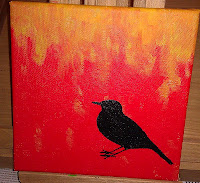 And then this morning I painted something else. I wanted to do something colourful, if only to contrast with the sad dreary painting, and something simple with a bird and a tree (birds and trees are my thing, don't ask me why). I painted this in about half an hour, which seems oddly short but felt quite right. The problem is, I don't know if it's finished. As you can see, I didn't paint the tree, which was going to be on the left, running out of frame, and I am not sure whether it needs the tree. I was going to add some blue or purple colour in the bottom, but I'm not sure whether it needs that either. I am really happy with what I have, the bird looks like it is falling over at first, but when you look at it longer you realise it isn't, and the background came out just like I wanted it. But is it finished? I don't know! With the first one I'm sure it isn't finished but I don't know what to add, while with this one I do know what I want to add, but I don't know whether I need to!
But if any of you have any good ideas or tips please please leave them in the comments. You don't have to do art or know about art, because neither do I, and really, I could use all the help I need!
But first, a short history.
My mother took a arts class when I was still very young, and I was very jealous of her, because she could draw an apple and it would look like a real apple, while mine would look like circles coloured in red and yellow with a brown line sticking out. I was never any good at drawing, but I did do it a lot, I even had my own comic book "series" (inspired on the Donald Duck magazine), which involved all the cats in the neighbourhood. This drawing-craze died out when I came into my teens, but when I went away for my studies I took my mother's (who had stopped doing anything years before) big box of painting-things with me and started doing watercolours, mainly because they're cheap (once you have the paint) and easy and it dries fast. I mostly made some fantastical children's-book-illustration-like images, some of which I quite like. I was really never any good, though, and soon I didn't have the time/energy/inspiration anymore (see The Creative Side), so I quit.
And then about a year ago my mother started taking art classes again, and she has become really good. I mean really good. She knows composition, and colours, and she paints a painting that would take you and me days in about 4 hours and then sits back and enjoys it. At first she also did some watercolours, but she quickly moved on to acrylics and oil paint. She does figurative things, and abstract, and blends, and everything! So every time I got home there would be another painting to see and like and discuss, and I got more and more restless again. I wanted to paint too! And in acrylics!
So I bought a lot of paint and some brushes and some cheap canvasses (it always starts with spending loads of money) and started to paint. Now I have always been very figurative in my paintings, I cannot do abstract and much as I love them, I could never do impressionistic paintings because they require you to paint something up close that does not really make sense until you are 3 meters away from it, and I need to see what I am doing. So I painted things. My first paintings were really childlike, looking like neatly coloured-in images, and so far removed from what I wanted it to be that I became frustrated and stopped doing it.
But then one day I was looking at one of the arty cards I got, and I realised I had been doing it all wrong. You see, in watercolours, if you don't want the colours to run into each other, you have to wait for the first layer to dry before you add the second, and you can have colours run into each other, but you can't really mix them, because then you end up with a big brown-greyish mash. But in acrylics, you don't wait for the bottom colours to dry, because then you get those bordered-off areas that seem to float on top of each other but do not relate to each other. You paint the first colour, let it dry a bit, and then you paint the second colour, and it's no problem if they mix a bit, because they will keep their colours or become a nice blend, but they won't turn all greyish. And then I got a big load of very nice small brushes for the Postcrossing-Sinterklaas thing I did, so I could paint smaller things, and then I started painting again.
 The first thing I painted you can see to the right (I am putting up quite bad quality photos from weird angles, with flash marks and bits of background showing on purpose, because I have seen stuff stolen on the Internet just a bit too many times. I could scan them and give you a high quality nice image, but I'm not gonna). It is not very happy, clearly, but it kinda looks like I wanted. But it isn't finished. I know it isn't because something is missing, and I think that something is colour, but I'm not sure, it may also be the fact that the statue seems to be floating and the bushes in the background look unrealistic, but I don't know how to fix that. I am really happy with the statue though, and with the tree, so that is good, although I am unsure whether I will ever finish this one. I would need some good advice or tips on how to do that without destroying the things I already have and am proud of, so I may write this off as my first "real acrylics" painting.
 And then this morning I painted something else. I wanted to do something colourful, if only to contrast with the sad dreary painting, and something simple with a bird and a tree (birds and trees are my thing, don't ask me why). I painted this in about half an hour, which seems oddly short but felt quite right. The problem is, I don't know if it's finished. As you can see, I didn't paint the tree, which was going to be on the left, running out of frame, and I am not sure whether it needs the tree. I was going to add some blue or purple colour in the bottom, but I'm not sure whether it needs that either. I am really happy with what I have, the bird looks like it is falling over at first, but when you look at it longer you realise it isn't, and the background came out just like I wanted it. But is it finished? I don't know! With the first one I'm sure it isn't finished but I don't know what to add, while with this one I do know what I want to add, but I don't know whether I need to!
Argh, the frustration!
Now I have ruined paintings in the past by doing or adding too much to them (something my mum is also suffering from), so I am just going to leave this one for the time being. It is kinda funny, because my class got cancelled today and I have the whole day to paint, but now I will stop doing it after an hour. That's just the way it goes. Inspiration is a fickle thing.But if any of you have any good ideas or tips please please leave them in the comments. You don't have to do art or know about art, because neither do I, and really, I could use all the help I need!
Wednesday, 1 February 2012
Street art cards
So yesterday I posted about my arty cards, but I somehow missed one of the most beautiful Van Gogh cards I'd received, this one;
No idea how I could have missed that, I was so happy when it arrived! Anyway, just wanted to give credit where credit is due.
And about six hours after that post on artiness yesterday, the universe decided to tell me that I was being a snob, by sending me my first Banksy card. No, actually, it was a girl from Lithuania, who had read my wishlist and saw that it mentioned both "street art" and "Banksy".
Now if you haven't done so already, please watch Exit Through the Giftshop, which is a documentary about a man making a documentary about Banksy, which turns out to be a documentary by Banksy about a man who makes a documentary about Banksy, or something like that. I know I have just given away the point, but if you have not seen this thing while it has been out there for 2 years, you won't be too bothered about that. And still, some great images of how street artists work, and how crazy things got when people decided that they were art and that they would pay thousands of dollars to have a bit of Banksy or whatever in their house. Now I wouldn't go as far as that, but I did get very happy checking out some of the street art in London and Rome while I was there, and maybe I got even happier when I received this card (couldn't find the artist anywhere, if you do know, please tell me!);
Yes, that is street art. And yes, that is Samuel Beckett (and it was sent by an Irish girl, what more could I want for?). Sadly I received this card about a month after I got back from London, because we were staying in Notting Hill at the time, and I would definitely have looked this one up as well.
And then there is Banksy;
Slightly less enthusiastic about this one, it is not one if his best works in my opinion, but a Banksy nonetheless! I do hope to receive more soon, but they seem to be in short demand!
 |
| CN-507120 received 17 January 2012 |
And about six hours after that post on artiness yesterday, the universe decided to tell me that I was being a snob, by sending me my first Banksy card. No, actually, it was a girl from Lithuania, who had read my wishlist and saw that it mentioned both "street art" and "Banksy".
Now if you haven't done so already, please watch Exit Through the Giftshop, which is a documentary about a man making a documentary about Banksy, which turns out to be a documentary by Banksy about a man who makes a documentary about Banksy, or something like that. I know I have just given away the point, but if you have not seen this thing while it has been out there for 2 years, you won't be too bothered about that. And still, some great images of how street artists work, and how crazy things got when people decided that they were art and that they would pay thousands of dollars to have a bit of Banksy or whatever in their house. Now I wouldn't go as far as that, but I did get very happy checking out some of the street art in London and Rome while I was there, and maybe I got even happier when I received this card (couldn't find the artist anywhere, if you do know, please tell me!);
 |
| IE-22446 received 20 June 2011 |
And then there is Banksy;
 |
| LT-182278 received 31 January 2012 |
Tuesday, 31 January 2012
Arty cards
Time to talk some more about Postcrossing, if only to keep those poor Russians and Ukranians and Japanese people (why are they always "Japanese people", and not just "Japanians" or something?) that keep straying into my blog happy (yes, I can see all sorts of data about you, curious blog-viewer).
So just a few days ago Postcrossing passed the 10,000,000 received-card mark, which was a reason for celebration, and shortly before that the Netherlands passed their 1,000,000 send-card mark with (obviously) NL-1000000. This does not mean that 1 million Dutch postcards have arrived, that number is still around 916,000, which just goes to show how many cards are still disappearing in the mail. I tried to get that magical round number, but despite some fast clicking I ended up with NL-999995 and NL-1000007. Ah well, at least I didn't stay up all night waiting for it, like some people on the forum (obsession can only go so far, really).
Anyway, the next item on my list after "Alice in Wonderland illustrations" is arty cards by Van Gogh, Monet, Renoir, Klimt, Dali, and Waterhouse. I love impressionism and surrealism and I've sent a lot of these cards, and also some by Rembrandt and Vermeer, because, you know, they were Dutch and all. But I can't say I've received a lot of them, really. The last two are non-existant, as is Renoir, to my great sadness, but I have received three Van Goghs, three Monets, one by Monets son Michel, and one Klimt (which I didn't even recognize as one at first). Most of these have come from the Netherlands, but I received this beautiful Monet card from Taiwan;
and this great Van Gogh card from Greece (a rare Postcrossing country);
I'd love to show you all my art cards, but I'm afraid you've either stopped reading or have scrolled to the bottom of this post to check how much more there is, so I am going to leave it at this, but not before saying that I think it is sad that there isn't more interest in art on Postcrossing, and that most people just send a touristy card from their hometown, which are not only cheap but also generally just plain ugly. But hey, to each their own, and I am just happy I do send art cards to those people asking for them!
Last but not least, one Dutch user send me this great Mondriaan card, as seen by Dick Bruna;
So just a few days ago Postcrossing passed the 10,000,000 received-card mark, which was a reason for celebration, and shortly before that the Netherlands passed their 1,000,000 send-card mark with (obviously) NL-1000000. This does not mean that 1 million Dutch postcards have arrived, that number is still around 916,000, which just goes to show how many cards are still disappearing in the mail. I tried to get that magical round number, but despite some fast clicking I ended up with NL-999995 and NL-1000007. Ah well, at least I didn't stay up all night waiting for it, like some people on the forum (obsession can only go so far, really).
Anyway, the next item on my list after "Alice in Wonderland illustrations" is arty cards by Van Gogh, Monet, Renoir, Klimt, Dali, and Waterhouse. I love impressionism and surrealism and I've sent a lot of these cards, and also some by Rembrandt and Vermeer, because, you know, they were Dutch and all. But I can't say I've received a lot of them, really. The last two are non-existant, as is Renoir, to my great sadness, but I have received three Van Goghs, three Monets, one by Monets son Michel, and one Klimt (which I didn't even recognize as one at first). Most of these have come from the Netherlands, but I received this beautiful Monet card from Taiwan;
 |
| TW-368306 received 21 September 2011 |
 |
| GR-18249 received 26 May 2011 |
Last but not least, one Dutch user send me this great Mondriaan card, as seen by Dick Bruna;
 |
| NL-966593 received 7 January 2012 |
Friday, 13 January 2012
Unfinished
Yesterday evening I watched a program on BBC2 called Unfinished, in which the attraction and use of unfinished art was discussed. Of course there was talk of Dickens's The Mystery of Edwin Drood, Austen's Sanditon and Coleridge's "Kubla Khan", but they also mentioned a portrait of George Washington that was deliberately never finished, and that has been on the 1 dollar bill for 100 years now.
Now I have to admit that I did not watch the whole program, so I may be saying some stuff that is unrelated or unrelevant, but as I thought about it this morning, there were two things that surprised me.
Firstly, when the presenter, Alastair Sooke, asked (random, non-Austen-reading) people whether they would rather read the unfinished Sanditon by Austen, or one of the completed versions by other authors, all of them chose the unfinished version (there may have been dozens who chose one of the others, but they were not in the program). All of them said something along the lines of "this is the way she meant it, and the other author doesn't know for sure how it was to finish" or "this is the real thing, because it is just her words". Now this is interesting, because there have been so many people who did try to finish it, starting with one of Austen's own nieces. So why do people try to finish novels, when others don't really want to read their versions? Is it just to satisfy their own curiosity, or because they are so sad or frustrated that it isn't finished? Do they really try to finish it so that others can read it, or do they write mostly for themselves? But why publish it then? I don't know the answer to these questions. I am also not a person who would read a finished version by someone else, or who would try to finish it myself, because it just is what it is, she died while she was writing it. The same goes for the Dickens story, which has recently been completed and turned into a tv series. Again, just to make money out of it? What purpose is served by finishing something that you don't know how to finish? We just don't know how it was supposed to end, can't we just leave it at that?
(Now I think I should put in a disclaimer for the Robert Jordan fans, because he also died before he could finish his Wheel of Time series, and Brandon Sanderson finished it (and added some more books in the process). Now Jordan actually wrote down how the series was supposed to end, and he wanted to choose his successor, but in the end his widow had to do that for him. So I think this is a very different situation, because the author knows that they are going to die, doesn't want to disappoint the fans of the series, and thus deliberately asks another writer to finish it for him. So here we actually know how it was going to end, and it is with the author's consent, which makes all the difference, to me.)
Secondly, the issue with the painting surprised me, and not only because I had never heard of it before. Apparently, Gilbert Stuart realised that he could make money from the unfinished painting, made 130 replicas, which he sold for a lot of money. So could we then really call the thing unfinished? I mean, Stuart clearly did not intend to finish it, because he could make a lot of money without doing so, and even Washington himself was quite content with the unfinished thing, he even ordered a replica for himself. So when do you call a painting unfinished, or finished for that matter? I know I have had difficulty deciding whether a painting was done, and I have heard other artists express the same problem. But can we call something unfinished when the artist clearly has no intention of ever going back to finish? I mean, if the artist isn't sure themselves, it is another issue, but in this case the label of "unfinished" just adds to the value of the thing. (The same really goes for "Kubla Khan", because it is generally thought that Coleridge just added the mystique of saying that he was interrupted when writing it, but this is what makes it so popular, the air of "there could have been so much more!" even when there really couldn't.)
For me, with a story (novel) it is different, because you have your overall story arch and when that is done the story is "done", and you can keep adding minor characters and in-between-scenes all you like, but when the story is told, it is finished (and for those authors who write in a linear manner, like Austen, it is even easier than for people like me, who jump ahead and leave blanks in the middle that may or may not be filled in at a later point). But for a painting... I don't know, maybe it is because I am more a writer than a painter, but sometimes an "unfinished" painting, with areas of canvas still showing, really is finished. And I would say that that is the case with Stuart's painting, because we can all agree that he never intended to finish it anyway.
So what is the draw of these unfinished works? Is it because we can fill it in for ourselves, imagine what the ending must be like, and thus in a way become artists ourselves? That is something you do whenever you read a book; you always have a picture in your head of what the characters or the buildings or the surroundings look like. With paintings it is the same, I think; I always try to imagine what lies outside of the canvas area, or what a scene would look like if it were painted from a different angle. So personally I cannot understand the obsession with finishing unfinished works by others, because I think that the only goal that is served by it is putting yourself in the shoes of the artist, and in the case of Austen or Dickens, those shoes are just a little bit too large for us to fill!
Now I have to admit that I did not watch the whole program, so I may be saying some stuff that is unrelated or unrelevant, but as I thought about it this morning, there were two things that surprised me.
Firstly, when the presenter, Alastair Sooke, asked (random, non-Austen-reading) people whether they would rather read the unfinished Sanditon by Austen, or one of the completed versions by other authors, all of them chose the unfinished version (there may have been dozens who chose one of the others, but they were not in the program). All of them said something along the lines of "this is the way she meant it, and the other author doesn't know for sure how it was to finish" or "this is the real thing, because it is just her words". Now this is interesting, because there have been so many people who did try to finish it, starting with one of Austen's own nieces. So why do people try to finish novels, when others don't really want to read their versions? Is it just to satisfy their own curiosity, or because they are so sad or frustrated that it isn't finished? Do they really try to finish it so that others can read it, or do they write mostly for themselves? But why publish it then? I don't know the answer to these questions. I am also not a person who would read a finished version by someone else, or who would try to finish it myself, because it just is what it is, she died while she was writing it. The same goes for the Dickens story, which has recently been completed and turned into a tv series. Again, just to make money out of it? What purpose is served by finishing something that you don't know how to finish? We just don't know how it was supposed to end, can't we just leave it at that?
(Now I think I should put in a disclaimer for the Robert Jordan fans, because he also died before he could finish his Wheel of Time series, and Brandon Sanderson finished it (and added some more books in the process). Now Jordan actually wrote down how the series was supposed to end, and he wanted to choose his successor, but in the end his widow had to do that for him. So I think this is a very different situation, because the author knows that they are going to die, doesn't want to disappoint the fans of the series, and thus deliberately asks another writer to finish it for him. So here we actually know how it was going to end, and it is with the author's consent, which makes all the difference, to me.)
Secondly, the issue with the painting surprised me, and not only because I had never heard of it before. Apparently, Gilbert Stuart realised that he could make money from the unfinished painting, made 130 replicas, which he sold for a lot of money. So could we then really call the thing unfinished? I mean, Stuart clearly did not intend to finish it, because he could make a lot of money without doing so, and even Washington himself was quite content with the unfinished thing, he even ordered a replica for himself. So when do you call a painting unfinished, or finished for that matter? I know I have had difficulty deciding whether a painting was done, and I have heard other artists express the same problem. But can we call something unfinished when the artist clearly has no intention of ever going back to finish? I mean, if the artist isn't sure themselves, it is another issue, but in this case the label of "unfinished" just adds to the value of the thing. (The same really goes for "Kubla Khan", because it is generally thought that Coleridge just added the mystique of saying that he was interrupted when writing it, but this is what makes it so popular, the air of "there could have been so much more!" even when there really couldn't.)
For me, with a story (novel) it is different, because you have your overall story arch and when that is done the story is "done", and you can keep adding minor characters and in-between-scenes all you like, but when the story is told, it is finished (and for those authors who write in a linear manner, like Austen, it is even easier than for people like me, who jump ahead and leave blanks in the middle that may or may not be filled in at a later point). But for a painting... I don't know, maybe it is because I am more a writer than a painter, but sometimes an "unfinished" painting, with areas of canvas still showing, really is finished. And I would say that that is the case with Stuart's painting, because we can all agree that he never intended to finish it anyway.
So what is the draw of these unfinished works? Is it because we can fill it in for ourselves, imagine what the ending must be like, and thus in a way become artists ourselves? That is something you do whenever you read a book; you always have a picture in your head of what the characters or the buildings or the surroundings look like. With paintings it is the same, I think; I always try to imagine what lies outside of the canvas area, or what a scene would look like if it were painted from a different angle. So personally I cannot understand the obsession with finishing unfinished works by others, because I think that the only goal that is served by it is putting yourself in the shoes of the artist, and in the case of Austen or Dickens, those shoes are just a little bit too large for us to fill!
Wednesday, 11 January 2012
Alice in Wonderland
One of the items of my Postcrossing wishlist is "Alice in Wonderland cards". I am a big fan of Alice and her creator, and would especially recommend the Annotated Alice for new readers, because there are many notes that explain some of the weird and wonderful things, the symbolism, and the references to mathematics. I am less charmed by the Disney movie, which strangely combines Alice's Adventures in Wonderland and Through the Looking-Glass, but I do like the new 2010 adaption by Tim Burton, especially because it calls itself an adaptation and does not take itself serious.
Now the original drawings of Alice (apart from those that Dodgson added to his own manuscript) were 42 wood engravings done by John Tenniel, and yesterday I received a postcard from Singapore with one of the illustrations and a little bit of text. I really love this card, which is quite small, 8 by 14 cm.
I think Tenniel's illustrations are sometimes quite coarse and childish, but they were checked and approved by Dodgson himself. Also, he had the pubisher destroy the first print run because he did not like the quality of the illustrations, which shows his commitment to his work.
However, Tenniel was not the only one to illustrate Alice, and as we had the version of someone else at home (a beautiful big book with glossy picture pages that stood out from the rough pages with the text) that is the version of Alice images that I grew up with and love the most. Arthur Rackham made 13 coloured illustrations for a new edition of Alice in 1907, and one of the first postcards I ever received was one of his images. Now this is one of the bigger cards I have received, and it is glossy like those illustrations in that book from long ago.
I know there is a very dramatic art noveau-esque quality to his images that not everyone will like (and I myself don't always like very much). As Charles Dodgson passed away in 1898, we do not know what his opinion of the illustrations was. But as Guillermo Del Toro has cited Rackham as one of the inspirations for his design of Pan's Labyrinth, I think we can all agree that Rackham's influence has been great indeed.
Now the original drawings of Alice (apart from those that Dodgson added to his own manuscript) were 42 wood engravings done by John Tenniel, and yesterday I received a postcard from Singapore with one of the illustrations and a little bit of text. I really love this card, which is quite small, 8 by 14 cm.
 |
| Card SG-53219, received 10-1-12 |
However, Tenniel was not the only one to illustrate Alice, and as we had the version of someone else at home (a beautiful big book with glossy picture pages that stood out from the rough pages with the text) that is the version of Alice images that I grew up with and love the most. Arthur Rackham made 13 coloured illustrations for a new edition of Alice in 1907, and one of the first postcards I ever received was one of his images. Now this is one of the bigger cards I have received, and it is glossy like those illustrations in that book from long ago.
 |
| Card US-1059430, received 4-4-11 |
Subscribe to:
Posts (Atom)