I can remember when the film The English Patient came out. Somehow, the film posters were everywhere. I must have been about 11, looking at the release date, but it feels more like I was 16 or 17. It went on to swipe almost every Oscar there was in the 1997 Academy Awards, but somehow, I never watched it. It felt too sappy romantic, with those typical sepia tones and the 'star-crossed lovers' lay-out of the poster. Not my cup of tea, at the time (again, I'm thinking of the 16-17 year old me. The 11 year old me went to Titanic with all the girls in her class and tried to be emotionally involved to fit in with the group, all the while wondering why anyone would bother spending 3 hours watching this).
Anyway, fast forward to 2018, the day I was scrolling through the past list of Man Booker Prize winners and discovered The English Patient (the novel) was on it. This came from even earlier, 1992, when I was just 7 and way too young to know anything about any of this. But, since reading as many Man Booker Prize winning novels as possible is one of my life goals, I decided this would be the perfect chance to redeem this lovey-dovey story. For that is still what I thought it was. I had absolutely no idea what this novel was about, except that there is an English patient in WWII, which made me think of the hospital scenes in Atonement. As I was about to discover, this novel was nothing like Ian McEwan's work, it was unlike anything I'd ever read before.
From the first page, the poetical language, the beautiful imagery, and the interesting style got a hold of me. This is a novel that challenges its reader. In the first part, nobody has a name. There is a woman, and a man, and then another man, but you're never sure whose point of view you're in, or when there is dialogue going on (there are no quotation marks around direct speech). Then an extra character is added, and you have the complete mix of the just four characters the novel comprises: the English patient, Hana, Caravaggio, and Kip. So much to be said, of so few people.
They live together in this desolate Italian villa, which used to be a hospital for the Allied forces, but before that was used as a headquarters by the Germans. Of course, I knew they had a WWII in Italy, but you never realise what was actually going on there. Same for the deserts of North Africa, where the story takes us in flashbacks; you somehow never realise that was all part of it because most of the stories you read are about the Western front; life in Britain, France, The Netherlands, Germany itself. I've read children's books about the war in the Dutch Indies, and several novels about the war in Asia (The Narrow Road to the Deep North being the one I will never ever forget (and another Man Booker Prize winner)), but none about Italy, or the African campaigns. As this novel taught me, it was just as big of a mess over there.
Anyway, I won't say too much about the plot, partly because it's not all that straightforward (lots of flashbacks, many parts where you're unsure whether someone is talking, and if so, who, unexpected time jumps, etc). There is a sense of mystery about all the characters, and we do not really get to know any of them, even though the novel wants us to think we do. Some of them turn out to be actual historical figures, although Michael Ondaatje fictionalised the events (which some people didn't entirely get, if the Wikipedia page is to be believed). But it's not about these people. It's about the language of the novel, the way it flows, the way in paints images, the poetry of it.
And that is also the weak point. I loved the first part. Maybe because it was new, maybe because I was getting into the novel, but I really lost myself in the words and the ideas the novel wanted to portray. I thought; this is going to be one of those novels I finish in a weekend and think about for a month afterwards. But then it sagged. Somehow, the language was still beautiful, but it didn't grab me anymore. Maybe because I was used to it, maybe because the middle part of a novel is always the lesser bit (one hopes, a disappointing ending is the worst), but for a couple of weeks in the middle, I couldn't get through. Then the story got up to speed again, and I finished the last 50 pages in a mad reading rush usually accompanying better novels.
In the end, it is a deserved Man Booker winner. Not only because it let me experience a piece of the past I was vaguely aware of, but mostly because of the writing style and the characters. But it was not all that I had hoped when I started on that first chapter. Also, I am now very curious to see what they did with it in the film, as such a non-linear story must be hard to capture on film. Somehow, it feels like it can only disappoint, especially if it is the romantic drama my 16 year old self thought it to be.
Interestingly, I am now experiencing the exact opposite: I have already seen the film version of The Sense of an Ending, and am now reading the novel by Julian Barnes (another Man Booker Prize winner). Here, the novel is straightforward, while the film includes interesting flashbacks and time jumps. So far, the novel greatly outshines the film. I have a sneaky suspicion The English Patient will too.
Sunday, 25 February 2018

Sunday, 21 January 2018
Uncommon Type
Over the past few weeks, I've discovered that most people have a typical Tom Hanks reference character. Even if they sometimes don't know the name of said character, when asked, they will say "Captain Philips", "The one from The Green Mile", "That guy on the island talking to a volley ball", "The guy from Polar Express" or simply "You've got mail" or "Catch me if you can". One even mentioned Woody from Toy Story. My personal reference character is Forrest Gump, although Saving Private Ryan is never far from my mind (I try actively not to think about that film at least once a week).
Anyway, the point is; Tom Hanks has played some wildly different characters over the years. You may think he is 'the rom-com guy' due to You've got mail and Sleepless in Seattle, but you can't exactly call Saving Private Ryan a rom-commy movie. He is pretty versatile in what he does, making very different characters come to life, and somehow most roles tend to stick in someones mind (although nobody mentioned Robert Langdon from the Dan Brown film adaptations, which I quietly thought was a good thing). That is quite a gift, compared to many type-casts who only know how to play 'the love interest' or 'the villain' or 'the ex-CIA/FBI agent returning for one last rogue operation'. (His female counterpart in this, to me, is Meryl Streep).
So why am I going on about the various acting jobs of Tom Hanks, while this post is clearly labelled as being about 'books' and 'reading'? Well, mr Hanks turns out to be even more versatile than I thought, as apart from acting in, writing, and producing films, he has also written a book. Not a novel, but a collection of short stories entitled Uncommon Type. Wikipedia tells us that as early as November 2014, "Hanks said he would publish a collection of short stories based on his typewriter collection". Just let that sink in: the man has a typewriter collection, which he writes short stories about, which he says he will publish, and three years later he actually does publish a short story collection about his typewriter collection. I mean, it is a combination of facts one would never expect to find with one person. This sentence alone deserves its own film!
Anyway, I put the book on my wishlist for my birthday, got it, and then it spent about three months sitting on a shelf, because it's a short story collection about typewriters by Tom Hanks; who would waste their time on that? But the reviews were pretty positive, and I was curious to find whether this really was only published because the author is famous so it will inevitably sell well, so I decided to make it my second read of 2018. If anything, it would fulfil my 'more short story collections' goal of 2018.
But it did so much more than that. Mr Hanks knows how to write. Seriously.
Apart from the first and last story, all stories are stand-alone; they differ in time, location, main character, and above all; plot. The first is from about 1910, if memory serves, and the last is set some time in the near future. The main characters range from a billionaire wanting to travel to the past via a Bulgarian immigrant sneaking into the US to a small-town actress trying her luck in New York City. Apart from one film script, the stories are all of the conventional type: 10-50 pages, prose with a nice twist towards the end (there are some newspaper articley bits in there, which I did not like and did not read, so I am disregarding those). The twists are not of Roald Dahl's bitter or cynical quality; nevertheless, they are good. Some of these stories made me put the book aside for a couple of minutes just to think about them. Some made me speed up my reading just to know for sure the main character would end up alright. Some were forgettable, not downright boring but with less well-written characters or themes.
Because it is the characters that make these stories. The plots are not surprising or unique in any way, there are too many stories on the acting/filming industry and others also includes American Dreamy subject matter that we have all seen before (again; for great short stories, check out Roald Dahl). But the characters are great. I really felt I got to know them in the few short pages I spent time with them. They were distinct, well-written and had a lot of character depth and development. This should not be surprising from an actor who has made his living being so many different people himself (ah, and so the blog post comes full circle), but it is still nice to have.
So what about these typewriters? Mr Hanks himself said he would write "short stories based on his typewriter collection". Well, the one combining element in all stories is that they each feature a typewriter. Not in a forced way; in some stories the typewriter is simply mentioned as part of the inventory of a room; in some stories one of the characters doodles around with one while waiting for other things to happen; but in some, the typewriter is important and in one (These are the meditations of my heart) it actually is the main plot element. In almost all stories, we get the make, colour, shape and age of the typewriter. The page preceding each short story shows a picture of the typewriter used in that story, probably all typewriters from Mr Hanks' personal collection. All, except for the last story. That does not feature a typewriter, but a bowling ball. The picture shows an object (could be typewriter, could be bowling ball) in protective casing. Now I wouldn't put it beyond Tom Hanks to also have a collection of bowling balls, and of at this moment writing a short story collection based on it. We will see in a couple of years... In the meantime, this will do just fine, even for those without a fascination for typewriters...
Saturday, 20 January 2018
Lemon and poppyseed cake: the sequel
So last week I made this very light lemon and poppy seed cake from a recipe by Yvette van Boven, and although it was great and lovely and light, it was a bit too much of a hassle for me to fit this into a quick Saturday afternoon bake. So I decided to try again, this time using a simple cake which I've been baking my entire childhood (the English would call it a pound cake), which requires only one bowl, a simple set of instructions, and no splitting of eggs. Also, no glazing. Let's see if this works just as well.
Ingredients
200 g butter
200 g sugar
200 g self-raising flour
2-3 eggs (combined weight should be about 200 g)
2 tablespoons poppy seeds
juice and peel of one lemon
Preheat the oven to 180 C and grease and line a baking tin. I used a loaf tin for this one.
Mix the butter and sugar together until creamy. Add the flour, poppy seeds, lemon juice and peel. Finally, add the eggs one at a time, and keep whisking for about 4-5 minutes after the last egg has been added to add as much air as possible (I made this cake in the KitchenAid, so no sore arms from too much whisking).
Pour the mixture in the baking tin and bake for about 40-45 minutes. Leave to cool.
If you want, you can add a glaze, but my teeth were still recovering from the last cake, so I didn't. We just had a slice, still-warm from the oven, with our morning tea.
So, the verdict. Is this easy, run-off-the-mill cake just as good as Yvette's fancy one?
Sadly, or gladly, depending on your point of view, it isn't. It's a pretty nice cake, but it is quite heavy and stodgy compared to the 'light' professional one. The texture really is much denser. The lemon doesn't come through quite as well in this cake, it tastes more buttery. All in all, this makes you feel as if you won't have to eat anything for the rest of the day, while the other cake somehow floats away to an airy memory.
Funny, isn't it, how using almost exactly the same ingredients, just a few simple differences in the method leaves you with two so wildly different cakes? The lack of airiness is all due to the lack of separately beaten egg whites, of course, and it is good to know that that makes so much of a difference. And Yvette's cake would have been even lighter if I'd followed her recipe and used 4 egg whites instead of 2.
Anyway, moral of the story is; more elbow grease and bowls to wash also gives you a better cake. And as it turns out, Yvette also has a recipe for a pound cake, one that does involve two bowls and egg splitting and separately beaten egg whites, but is otherwise almost as simple as the one above. This, combined with the lemon juice and poppy seeds, may well be the holy grail of lemon and poppy seed cakes; stay tuned!
Sunday, 14 January 2018
Very light lemon and poppy seed cake
My previous recipe by Yvette van Boven was a hit, so I decided to try another one this weekend. I made a lemon and poppy seed cake a long, looong time ago (turns out it was 2012... can you believe it?), so it was high time I made another! The poppy seeds took some time to get a hold of, but when those were in my possession, I was ready for the 'very light' lemon and poppy seed cake that Yvette describes. Technically the recipe isn't her own, as she describes a friend buying a lemon and poppy seed cake bought in London and recreated from the ingredients list. Whichever way she came by it, I decided to try it out.
Usually I try to follow new recipes to the letter, but this time I had some reservations against that. Firstly, the recipe required 6 eggs; 2 whole and 4 egg whites. I have nothing against baking with eggs, but 6 felt a bit too extravagant for 'just a cake' (must be my Dutch nature playing up). So I brought that down to 2 whole eggs and 2 egg whites. Secondly, if you follow this recipe properly, you need 4 bowls. I don't know how large your kitchen is, but I do not have 4 mixing bowls. Thirdly, the glazing required 250 grams of icing sugar, which is sweet enough to reduce your teeth to rotting black stumps. So I reduced that to more normal proportions. And finally, to whisk egg whites, you need a very clean bowl and very clean mixer. According to the recipe, I had to mix all the other ingredients first, then clean the whisks, and then whisk the egg whites. What with all the bowls and organisation going on already, this felt like too much hassle. So I whisked the egg whites before doing anything else, thus probably violating about 3 Main Baking Laws, but making my own life a little easier.
So, that brings me to the actual story:
Ingredients:
200 g butter, at room temperature
200 g white muscavado sugar
2 whole eggs
peel and juice of 2 lemons
2 tablespoons poppy seed
200 g flour
5 g baking powder
2 (or 4) egg whites
For the glazing:
juice of one lemon
120 (or 250) g icing sugar
You can make this cake in either a loaf tin or a round tin. I used a round tin, to get a more 'cakey' feeling, and because this gives you bigger slices to serve to friends (I always try to bake when I know people will be visiting, so I won't have to eat too much cake). Anyway, grease the tin and line with baking parchment. Preheat your oven to 170 C.
I started by mixing the egg whites together with a pinch of salt until firm enough for the bowl to be held upside down. Officially, this step is after the adding of the dry ingredients to the wet.
Mix the butter and sugar until smooth. Add the eggs one at a time, beating well in between. Add the lemon peel, juice and poppy seeds and mix well.
Sift the flour and baking powder together over the mixture, and spoon through until the mixture is smooth.
Add the whisked egg whites; first add one spoonful and incorporate this well, then add the rest and stir until combined. Pour the mixture into the prepared tin and bake for about 30 minutes.
This cake has a relatively high sugar content, so it will brown quickly. Do not be fooled into thinking it is more baked than it is; an underbaked cake will collapse (as mine did). Also, it will stick to the tin, so make sure to grease the tin really really well.
When your cake is done, take it out of the oven and let it cool for a couple of minutes before turning it out.
To make the glazing, simply mix the lemon juice and icing sugar until you have a runny consistency. Pour over the (slightly cooled) cake and leave to harden.
Now, as I mentioned, my cake had collapsed slightly in the middle. This meant that all the glazing pooled into the dip in the middle, making the first small bites from the middle very very lemony. Also, the 'crust' stuck to the tin when I took it out, so bits of the 'crust' were lost as trimmings
But the texture of the cake came out perfect. Not just light, as the recipe says, but almost fluffy. This may well be one of the best cakes I've ever made, crumb structure wise. Even Mary Berry may have been impressed. The poppy seed taste came out well, although the lemon is a bit too strong in comparison. I will use less lemon juice in the glazing in the future, as it takes away from the actual cake taste. But otherwise, it was pretty close to perfect, and I won't wait another 6 years before making another lemon and poppy seed cake.
Usually I try to follow new recipes to the letter, but this time I had some reservations against that. Firstly, the recipe required 6 eggs; 2 whole and 4 egg whites. I have nothing against baking with eggs, but 6 felt a bit too extravagant for 'just a cake' (must be my Dutch nature playing up). So I brought that down to 2 whole eggs and 2 egg whites. Secondly, if you follow this recipe properly, you need 4 bowls. I don't know how large your kitchen is, but I do not have 4 mixing bowls. Thirdly, the glazing required 250 grams of icing sugar, which is sweet enough to reduce your teeth to rotting black stumps. So I reduced that to more normal proportions. And finally, to whisk egg whites, you need a very clean bowl and very clean mixer. According to the recipe, I had to mix all the other ingredients first, then clean the whisks, and then whisk the egg whites. What with all the bowls and organisation going on already, this felt like too much hassle. So I whisked the egg whites before doing anything else, thus probably violating about 3 Main Baking Laws, but making my own life a little easier.
So, that brings me to the actual story:
Ingredients:
200 g butter, at room temperature
200 g white muscavado sugar
2 whole eggs
peel and juice of 2 lemons
2 tablespoons poppy seed
200 g flour
5 g baking powder
2 (or 4) egg whites
For the glazing:
juice of one lemon
120 (or 250) g icing sugar
You can make this cake in either a loaf tin or a round tin. I used a round tin, to get a more 'cakey' feeling, and because this gives you bigger slices to serve to friends (I always try to bake when I know people will be visiting, so I won't have to eat too much cake). Anyway, grease the tin and line with baking parchment. Preheat your oven to 170 C.
I started by mixing the egg whites together with a pinch of salt until firm enough for the bowl to be held upside down. Officially, this step is after the adding of the dry ingredients to the wet.
Mix the butter and sugar until smooth. Add the eggs one at a time, beating well in between. Add the lemon peel, juice and poppy seeds and mix well.
Sift the flour and baking powder together over the mixture, and spoon through until the mixture is smooth.
Add the whisked egg whites; first add one spoonful and incorporate this well, then add the rest and stir until combined. Pour the mixture into the prepared tin and bake for about 30 minutes.
This cake has a relatively high sugar content, so it will brown quickly. Do not be fooled into thinking it is more baked than it is; an underbaked cake will collapse (as mine did). Also, it will stick to the tin, so make sure to grease the tin really really well.
When your cake is done, take it out of the oven and let it cool for a couple of minutes before turning it out.
To make the glazing, simply mix the lemon juice and icing sugar until you have a runny consistency. Pour over the (slightly cooled) cake and leave to harden.
 |
| Not an optical illusion: that is quite a dip in the middle. |
Now, as I mentioned, my cake had collapsed slightly in the middle. This meant that all the glazing pooled into the dip in the middle, making the first small bites from the middle very very lemony. Also, the 'crust' stuck to the tin when I took it out, so bits of the 'crust' were lost as trimmings
 |
| Pretty, pretty crumb structure! |
But the texture of the cake came out perfect. Not just light, as the recipe says, but almost fluffy. This may well be one of the best cakes I've ever made, crumb structure wise. Even Mary Berry may have been impressed. The poppy seed taste came out well, although the lemon is a bit too strong in comparison. I will use less lemon juice in the glazing in the future, as it takes away from the actual cake taste. But otherwise, it was pretty close to perfect, and I won't wait another 6 years before making another lemon and poppy seed cake.
Tuesday, 9 January 2018
Lincoln in the bardo
So, the first novel of 2018 is a fact! Although, maybe it wasn't really a novel... I decided to keep up with the Man Booker winners and get started on Lincoln in the Bardo, the 2017 Man Booker winner and the second American novel in a row to do so. The first one, The Sellout, was a huge disappointment, and as this novel had beaten Mohsin Hamid's Exit West (which should have won, really), it had to be pretty good to keep me happy.
At first glance, it was mostly... weird. I'd been somewhat prepared to that due to a review I'd read, but still, it took me a while to 'get' it. The novel starts with someone recounting a pretty silly story, until other voices seem to burst into the conversation, and then the chapter is suddenly finished. The next chapter consists of snippets of (real?) historical sources, all recounting something about Abraham Lincoln. Which in no way has any relation with chapter one. Then more 'talk' from the characters introduced in chapter one, and then more historical sources. Quite puzzeling. And it could have been quite annoying, so much so that I might have put the thing down never to pick it up again, but there is something that kept me reading, something in the style of writing or the events described (everything is described by the characters, it is all dialogue, or rather intertwined monologues).
And as I got into it, a picture started to emerge. I won't give too much away, for the discovery of what is going on is half the joy of reading. But all these characters were so confusing because they didn't realise the position they were in, or were in denial of it. They were unreliable narrators, but unintentionally. And the historical sources were there to give some sort of a frame for the other events, ordered in such a way that they provide the necessary background information for the rest of the story. These 'historical' (I'm still not sure whether these were real sources) texts were pretty reliable, apart from the bit where they all gave Abraham Lincoln different coloured eyes.
The book has over a hundred chapters, but somehow I flew through them, feeling dazed and confused when it was all over. The pacing is somewhat off; the first chapters feel very slow and uneventful, and then suddenly everything is in motion and happening at the same time. The plot is equally unbalanced. Not in an annoying way, but it makes you wonder whether it couldn't have been done differently. There are some truly funny bits, and also some moving bits, with one slightly disturbing image that keeps coming back. The characters are flat as pancakes, but they cannot help themselves, there being so many and them only able to describe events and their own emotions. The style, the combination of monologue and historical sources, and the choice of words and language, is the main selling point.
So the overall verdict? Way, way better than The Sellout. A deserved winner over Exit West? No way. But as an experiment in style and subject matter, it is truly well done. It gives me similar feelings as The Luminaries by Eleanor Catton; a lot of preparatory work went into the 'framework' of that novel as well, and sometimes the story collapses under all that structure. This novel holds up on its own, mostly due to the author's writing style. Apparently, George Saunders said he's never written a novel, and Lincoln in the Bardo shouldn't be considered his first, as it is not a novel at all. I somewhat agree with him, but I also hope he will put his considerable talents towards actually writing a novel soon. That may, in years where there are no other favourite authors to compete, be Man Booker worthy.
Friday, 5 January 2018
Healthy fruitcake
So one of my favourite new baking-recipe sources is Yvette van Boven. If you aren't Dutch you've probably never heard of her, but she is a great and funny and down-to-earth baker/cook. I bought her baking cookbook Home Baked with the book coupons I got for my birthday.
Yvette van Boven combines classic Dutch recipes with Irish inspiration, as she grew up in Ireland. Since my baking style is also a mix of Dutch and English, influenced by years of watching The Great British Bake-Off, this suits me perfectly. Today, I didn't really know what I wanted to bake, so I let my boyfriend pick out something easy that didn't involve pie-crusts (my arch nemesis). His suggestion: almond-fruitcake.
Now Yvette also likes to include recipes that are gluten or 'fast sugar' free, and this is one of those recipes. As such, it includes almond flour, which turns out to be one of the most expensive things ever. You could probably get away with using wheat (or any other kind of) flour, but we shall see what the almonds add to the taste when the cake gets out of the oven.
Ingredients:
250 g almond flour (or wheat, probably)
1 tablespoon cinnamon
1/2 teaspoon bicarbonate of soda
1/2 teaspoon salt
1 apple or pear, cored and diced
100 g dried apricots (I cut these into smaller pieces too)
100 g dried prunes (cut, althoug the recipe doesn't tell you to)
50 g walnuts
4 eggs
1 teaspoon of honey
about 75 ml water
Grease a loaf tin with olive oil (if you want to be all vegan about it) or butter, line with baking parchment. Preheat your oven to 170 C (fun fact: Yvette also wants you to get an oven thermometer, so I now know exactly how hot my oven is. Turns out it is a lot cooler than it thinks it is).
Mix the dry ingredients in a bowl. Mix the fruits and nuts in another bowl, and combine with the dry ingredients. Then, lightly whisk the eggs together with the honey and add that to the dry mixture.
 |
| Fruity cake filling mixture |
Now at this point Yvette tells me to 'add water until the mixture becomes creamy. This may be 50 ml, this may be 75'. However, my mixture was already pretty creamy. I checkt again, and turns out my apricots and prunes weren't actually the dried-dried fruits she mentioned, but just semi-dried and stuck in a package. So I didn't add any water. But if you have proper dried fruits, I'd add some water.
Pour the mixture into the prepared caketin and bake for about 40-50 minutes.
Now the only raising agents in this cake are the bicarbonate and the four eggs (lightly whisked) while there is a lot of heavy fruit in there. I was very curious to see whether this would come out looking anything like a cake, or more a stodgy lump. Luckily, I need not have worried.
 |
| Fruity fruitcake |
It was a proper cake, although not really the lightest cake I've ever eaten. Chock full of fruits and nuts, with sweetness from the cinnamon and honey coming through, while ate the same time feeling very very healthy. Not much of the almond flavour coming through, although the texture is a bit different than with a wheat flour cake. Still, I do think wheat flour would work.
The recipe picker declared this 'the best cake he'd ever eaten', so all was well in that regard.
Because I used so many large 'wet' fruits, the cake does somewhat fall apart when you slice it. If I'd known this beforehand, I would have cut the fruit in smaller pieces. So; dried fruits are okay to be a bit on the large size, fresh fruit should be cut. But that is mostly a logistical issue; flavour wise, it is great!
Sunday, 31 December 2017
Books of 2017
Another year in books has flown by. After my book challenge in 2015, I've been keeping lists of all the books I read through 2016 and this year. As in previous years, I'm always surprised to find which books I read not even half a year ago; amazing how quickly you forget when it was that you read something. On the other hand, some novels I feel like I've just finished them while that turns out to have been more than a year ago.
No reading goals, just keeping up the numbers. I read 23 books this year, which is 2 up from last year. Mainly, I think, because I didn't tackle any big literary reads (like Anna Karenina last year) and there were some rereads, which are always faster. As always, some books have already been discussed at length, while others may have their first mention on this blog right below.
The complete list for 2017:
1 The High Mountains of Portugal
2 The Sellout
3 Juliet, naked
4 Black Swan Green
5 The Outrun
6 Last Orders
7 The Handmaid's Tale
8 How to be good
9 The Jane Austen book club
10 Harry Potter and the Half-Blood Prince
11 Hag-Seed
12 The Joy Luck Club
13 England and other stories
14 Mijn Meneer
15 The Light Years
16 The North Water
17 Marking Time
18 Here I am
19 Confusion
20 The Best of Adam Sharp
21 Cloud Atlas
22 Exit West
23 Casting Off
So, five rereads; Juliet, naked, Black Swan Green, The Jane Austen bookclub, Harry Potter, and Cloud Atlas, two of which are by the ever-popular David Mitchell. The Joy Fowler and JK Rowling were because there was a bit in the summer where I wanted to read but not invest actual brainpower into the reading, so I went back to some really easy rereads. Only one Dutch book, which is also the only non-fiction title on the list (although it is partly fictionalized, it is the autobiographical account of Ted van Lieshout's youth). Technically only one short story collection (England and other stories), although one could count The Joy Luck Club as short stories (I read one of the chapters as a 'separate' short story during my studies). No classics at all. I was going to say 'no Americans' until I realised both The Sellout and Here I Am are written by Americans; somehow they both disappeared from my mind pretty quickly. No new novels by Ian McEwan, or David Mitchell, or any of my other popular authors, simply because there weren't any. Actually, now that I think of it: no Ian McEwan at all this year. After the triple McEwan there may have been a slight overdose, but still; this must be the first time in about 10 years that I read no novel by Ian McEwan for a whole year. This will surely be rectified in 2018.
Let's break the novels that I did read down into some lists:
Best English novel
1 Exit West
2 Last Orders
3 The Handmaid's Tale
A difficult choice this year! Exit West is clearly the winner; another Mohsin Hamid novel that I dearly loved. It is a very contemporary novel, featuring a couple from a unspecified Middle Eastern country fleeing through one of the mysterious doors that keep opening up all over the world, leading to other places. It is both mystical and very realistic, and I'm sad it didn't make Man Booker this year, as it would have been a deserved winner (I've just started reading the novel that did win, and Exit West would beat it with its hands tied behind its back at this point). Do read something by Hamid!
Last Orders is Graham Swift's Man Booker 1996 winning novel, which gave me the combined emotions of a WWII novel and The Full Monty, with it's 'band of brothers'-like bantering and the emotions simmering under a surface of beer and beautiful language. Same goes for The Handmaid's Tale; it's old, it's great, I've written all you need to know when I read it. Funnily enough, both Last Orders and The Handmaid's Tale could count as my 'classics' this year; they are both over 20 years old, and still very current.
Best Dutch novel/classics
Non-existent this year. Strange, as I did get lots of new novels, and have a pretty long backlog in both these categories. They must never have been at the top of the to-read list.
Best non-fiction/best short story collection
Only one novel in each of these categories this year, so not really lists to speak of.
Best fantasy/scifi novel
1 Exit West
2 The Handmaid's Tale
3 The High Mountains of Portugal
Not a lot of these to go around either, but I would of course have put in Cloud Atlas and Black Swan Green if they hadn't been rereads. Two of these also feature in my Best English novel list, but The High Mountains of Portual deserves special mention. Yann Martel, like Mohsin Hamid and David Mitchell, can capture you with a world that is very much like ours, but than turns out to be slightly unlike ours in a magical way, and your suspension of disbelief just goes with that until you find yourself in their made-up world still fully believing that these things could really happen here and now. Realistic fantasy, a true escape into literature.
Best 'new' author
1 Elizabeth Jane Howard
2 Graham Swift
3 Margaret Atwood
Only Elizabeth Jane Howard is really a 'new' author for 2017, and I've written enough about her novels in my previous blog post. But Graham Swift and Margaret Atwood are some of my recent discoveries of whom I want to read more. I'd read my first novel by Swift, Mothering Sunday, as one of my last novels in 2016 and this year I continued with Last Orders and his short-story collection England and other stories. I'd have wanted Wish you were here on the list as well, but it went into reprint just as I ordered it, so that will have to go for 2018 (when I wrote about Last Orders in March it had also disappeared from view in the bookshop, so I'll have to look into that...). Margaret Atwood is not really a 'new' author for me, as I read Oryx & Crake during my English studies, but she is one of the authors I've put on my 'must read more' list. This year I read The Handmaid's Tale and Hag-seed, both of which are great in their own way. I got The Heart goes Last a couple of weeks ago, so she will also feature in the 2018 list.
Most disappointing novel
1 How to be good
2 The Sellout
3 The Outrun
(4 The Best of Adam Sharp)
Wow, this was really the easiest category to fill this year. Not a good sign. I was looking forward to How to be good, one of the few Hornby novels I'd never read, but it was thoroughly disappointing. Moralistic, full of angry relationship issues, with a wavering plot and unlikeable characters. The Sellout was the Man Booker winner of 2016, so naturally I read it, but I didn't like it at all. It is supposed to be a funny social commentary on contemporary America, but I can't remember finding any bit of it funny. The main character struck me as pathetic, his backstory was unbelievable and the plot even more so. The Outrun appeared to be good at first; girl returns to small town Orkney life after her big-city London life blows up in her face, but in the end it didn't really go anywhere, the character didn't come to life for me as in so many of these 'woman retreats to find herself' novels. Special mention for The Best of Adam Sharp, again a novel by Graeme Simpsion that disappointed. It felt like a slight do-over of The Rosie Project, with some High Fidelity elements thrown in. He really turned out only one good novel, his first, and I will now stop reading whatever else he writes until the recommendations tell me it really is too great to miss.
Authors I read more than once
- Elizabeth Jane Howard (4x)
- Margaret Atwood (2x)
- Graham Swift (2x)
- Nick Hornby (2x, one reread and one new)
- David Mitchell (2x, both rereads)
Wednesday, 27 December 2017
Elizabeth Jane Howard
My 'books of 2017' list will be coming up shortly, and I'll already give a sneak peek at one of my absolute favourites this year: Elizabeth Jane Howard. Or more specifically; her series of novels about the Cazalet family. The first of these, The Light Years, was only this year translated into Dutch, even though the original novel stems from 1990. Due to the raving review of the translation, I decided to buy the original. Talk about hidden treasure!
The first novel is set in 1937 and follows the Cazalet family on the brink of WWII. "The Cazalet family" is not easily described, but in essence we follow two generations; the Cazalet brothers and sister, Hugh, Edward, Rachel and Rupert and their spouses, and the generation of their children. I'm now in the fourth novel of the series, Casting Off, which is set in the post-war time of 1946-1947. I don't know about the fifth part, which was published much later than the first four, but so far I've seen the 'junior' generation grow from 4-16 years of age to 14-26, which means some of them have children of their own now. The Cazalet family is ever-expanding, through marriage and child-birth, and some of the family friends have also become part of the Cazalet clan. As in any good novel, some of these characters have found their deaths, too.
The 'older' generation, having lived through yet another great War, have had their own fair share of developments, but it is really the younger one the first novels focuses on, especially the cousins Louise, Polly and Clary. And after having been with them for four novels and ten fictional years, it really feels as if I've gotten to know these characters, as if they are people who might live just down the street. Even though they are close in age, and clearly have inherited some of the more persistent family traits, the cousins are three very distinct personalities. They have each made some difficult life choices that have got them where they are now. It can get a bit chick-flicky (lots of relationship talk, lots of affairs), but there is more to these novels than that.
Apart from the characters, which are very well-developed and written, there is the language. Long, drawn-out sentences full of description, which perfectly set the atmosphere. Some of the characters are focused on interior design or clothes, and their chapters contain detailed descriptions of all the rooms and garments they see around them. In other chapters, a few sentences set the scene. The dialogue is also very well done, you can actually hear the characters talk, and even though there is very little 'she said sulkily' or 'he said pointedly', you can get the gist of the emotions simply from the writing.
Then there is the interesting fact that the author was actually born in the same year as the aforementioned cousins. She actually lived through these times. And it is in the small details that this becomes clear; having to get by on rations, getting creative with the small amount of food or clothes coupons that one had, the information about the Cazalet family's business in hard woods, and most importantly; the way people interacted with each other. The verisimilitude is very strong. The discovery of this series of novels coincided with my discovery of the tv series The Crown, which is set in roughly the same time. Both really let you drown in a time seventy years gone, making the past come alive.
Most surprisingly about the interaction between people is the position of women. Already, some of these characters who had maids and cooks and 'dailies' before the war, are having to fend for themselves in the post-war times, when young girls didn't 'go into service' anymore. You can see the class differences disappear before your eyes, you can see women try to carve out a position for themselves, either in a job, in their marriage, or in the new-found possibilities of divorce or emigration. The social change that the war brought about is really the overarching theme of the novel, starting with the Victorian attitudes of the grandparents, through the elder Cazalet brothers' defining experiences in WWI, and the upheaval WWII brought about.
But don't let these heavy themes fool you; these novels are really about people, people trying to find their way, in the light years, marking time, in confusion, and casting off, as the novels are so aptly named. They are one family, but apart from the family business they don't share all that many common goals, until the outside world starts to press in. It makes you feel privileged that you have been allowed to have a peek at their lives for so long.
As I said, I'm almost done reading novel number four. I could have finished all of them ages ago, but these are the kinds of novels you want to draw out, to read one or two other novels between subsequent parts of the series so you can go back and reconnect with these characters, so you won't gobble it all up in one go. I'm very curious about the last part in the series, All Change, but I won't get to that until we're some way into 2018. Hopefully, the best will have been saved for last. And otherwise, there are some more novels by Elizabeth Jane Howard to discover!
Thursday, 7 December 2017
Blueberry cake
So I've had my birthday in October, and of course I did some birthday baking. Normally I plan this pretty far in advance, but this year that somehow didn't happen, so I had to make a rather on-the-spot decision about what to make. For some reason (because they were on sale) I had lots and lots of blueberries. So naturally, I made a blueberry cake.
Looking for recipes for a blueberry cake, I came to the conclusion that you can either make:
- a plain cake with added blueberries
- a blueberry cheesecake
As my other cake was a mon chou cake, I didn't want to go for the cheesecake option, but just a plain cake with added blueberries sounded dull. So my solution was basically to make one giant blueberry cupcake, and call it a blueberry cake. And it was quite the hit!
Ingredients:
175 g butter
175 g sugar
3 eggs
225 g self-raising flour
1 tablespoon lemon zest
blueberries (I can't remember how many, but quite a lot. I think about 200-250 grams? Use fresh blueberries, not frozen ones)
For the frosting:
150 g mascarpone (I'd use cream cheese, but we don't have proper cream cheese here)
50-75 g icing sugar (depending on how sweet you want the frosting to be)
some blueberries to decorate
Preheat the oven to 180 C. Grease a sandwich tin and line with baking parchment.
Mix the butter and sugar together until creamy. Add the eggs one by one, the lemon zest, and the self-raising flour. Finally, use a spoon to stir in the blueberries (if you do this by electric mixer they will get mashed up). Spread the mixture in the cake tin and bake for about 50 minutes.
Let the cake cool completely, turning it out onto a plate or wire rack about 5-10 minutes after opening the oven.
Make the frosting simply by combining the mascarpone or cream cheese with the icing sugar. Add the icing sugar in small lumps and taste in between. The cake is not very sweet, so the frosting shouldn't be too sour if you like a sweet cake. Spread the frosting over the cake in any way you like and decorate with the remaining blueberries.
Final judgement? What works for small blueberry cupcakes unsurprisingly also works for large(r) blueberry cakes. The cake was very moist and not too sweet, the blueberries went well with the mascarpone, basically all was well with the world. A perfect cake for late summer or early autumn, when blueberries are actually in season (one of the perks of having your birthday early autumn: all kinds of nice fruity things are plentily available).
In the future, I will try more of these cupcake-turned-into-real-cake experiments!
Looking for recipes for a blueberry cake, I came to the conclusion that you can either make:
- a plain cake with added blueberries
- a blueberry cheesecake
As my other cake was a mon chou cake, I didn't want to go for the cheesecake option, but just a plain cake with added blueberries sounded dull. So my solution was basically to make one giant blueberry cupcake, and call it a blueberry cake. And it was quite the hit!
Ingredients:
175 g butter
175 g sugar
3 eggs
225 g self-raising flour
1 tablespoon lemon zest
blueberries (I can't remember how many, but quite a lot. I think about 200-250 grams? Use fresh blueberries, not frozen ones)
For the frosting:
150 g mascarpone (I'd use cream cheese, but we don't have proper cream cheese here)
50-75 g icing sugar (depending on how sweet you want the frosting to be)
some blueberries to decorate
Preheat the oven to 180 C. Grease a sandwich tin and line with baking parchment.
Mix the butter and sugar together until creamy. Add the eggs one by one, the lemon zest, and the self-raising flour. Finally, use a spoon to stir in the blueberries (if you do this by electric mixer they will get mashed up). Spread the mixture in the cake tin and bake for about 50 minutes.
Let the cake cool completely, turning it out onto a plate or wire rack about 5-10 minutes after opening the oven.
Make the frosting simply by combining the mascarpone or cream cheese with the icing sugar. Add the icing sugar in small lumps and taste in between. The cake is not very sweet, so the frosting shouldn't be too sour if you like a sweet cake. Spread the frosting over the cake in any way you like and decorate with the remaining blueberries.
 |
| Blueberry galore (I kept the most gigantic ones to decorate). |
Final judgement? What works for small blueberry cupcakes unsurprisingly also works for large(r) blueberry cakes. The cake was very moist and not too sweet, the blueberries went well with the mascarpone, basically all was well with the world. A perfect cake for late summer or early autumn, when blueberries are actually in season (one of the perks of having your birthday early autumn: all kinds of nice fruity things are plentily available).
In the future, I will try more of these cupcake-turned-into-real-cake experiments!
Fluently flu-ish
Wow, time flies! This reads like one of those obligatory "I'm not dead!" posts after a long period of blogging silence, but it is also honestly how I feel. The last couple of days I've been under the influence of a very violent and persistant virus, having what is euphemistically called 'stomach flu', but which I like to rename 'a snake writhing around in your intestines trying to rearrange som organs'. It wasn't pretty. I won't go into more detail.
But! Lots of other stuff happened, since my last post and before I got the bug. I've been promoted, meaning I am now no longer a generic-sounding 'project manager' but rather a 'publisher'. Sounds posher, is significantly more tricky to fill in on an entry-card to exotic holiday destinations (the first time I went to Africa the steward on the plane suggested we were creative with our job descriptions, putting 'artist' if you were a photographer, or 'writer' when you were a journalist; it would save us lots of time at customs. Sadly, I'd forgotten that by the time I went to Morocco in 2016, and I put in 'publisher' as my profession as 'project manager' wouldn't fit in the teeny-tiny space, and the customs official grilled me for 5 minutes about what I did, who I worked with, what kind of books I published, until he decided that school books must have something to do with the government, I wasn't a radical self-publishing element, and could safely be let into the country).
Also, I had my birthday (more on birthday baking in a next post), I visited London for a week, staying at a great Airbnb and enjoying it more than I'd expected from a city I've already visited six times, and of course I did lots of reading (birthdays always mean more books!). All of that and more, still to come, when I feel more like a human being than home to an intestinal snake!
Friday, 29 September 2017
Rocky road
Rocky road, one of those fabulous things you are sure must be American (who else throws so many calorie rich things into melted chocolate and calls it dessert?) but actually turns out to be European (or not; the origins remain unclear). Wherever it came from, it is definitely here to stay, and to my surprise I realised I'd never made it myself. While it is one of the easiest recipes to make, one of my colleagues actually had his 8 year old daughter make it for his birthday treat.
So, for a quick (but very rich) and easy (no baking involved) treat:
Ingredients
400 g chocolate (I used 200 g milk and 200 g dark)
250 g butter
100 ml golden syrup
Melt all these in a heatproof bowl over boiling water, until well combined. Then, you can add whatever you like, but classic ingredients include:
- crushed digestive biscuits
- raisins/sultanas/dried cranberries
- marshmallows
- nuts
For mine, I added:
200 g digestive biscuits (crushed)
100 g dried cranberries
about 10 marshmallows sliced into smaller bits
I left out the walnuts because I was planning to put in M&Ms, but then I forgot about the M&Ms, so the chocolate/filling ratio was not ideal. Will have to try again.
Anyway, line a tray with baking parchment. Stir the biscuits into the chocolate mixture, and then stir in any other ingredients you have until they are well covered in chocolate. Pour the mixture into your prepared tray and leave to set in the fridge for at least 3 hours, preferably overnight. Slice into small cubes (veeeery small cubes, it is very rich). The recipe makes quite a lot (depending on how small you cut them) so you could halve the ingredients for a more modest amount.
I wouldn't consider it a dessert myself, more something you have with a cup of tea after a long day (or during a film festival, which is where I handed out most of mine to grateful friends and other festival goers). Easy, quick and delicious!
Sunday, 17 September 2017
Devil's food cake
So after making my apple cake last week, I came to the horrible realisation that I'd never actually made a chocolate cake. Not a proper one, I have made cakes in which I added a load of cocoa powder, but that doesn't make it an 'official' chocolate cake. So I dove into Mary Berry's recipes, and decided to make one that was called 'Devil's food cake'. I'd never heard of this cake before, but after making it, I have an idea of why it's called that way. Read on, and you will know too.
To manage expectations; this cake did not turn out well. It must be Murphy's law, because just a couple of days earlier someone (my mom) told me that my cakes always turn out great and that I've never had a bad bake. Well...
I've put the recipe below, adding in italics the points where something went wrong with my cake, and how you could avoid making my mistakes in the future. And also how I could avoid making my own mistakes again, as I will be making this cake again, to do it properly.
Ingredients
for the cake:
50 g cocoa powder
255 ml water
100 g butter
275 caster sugar
2 eggs
175 g flour
teaspoon baking powder
teaspoon bicarbonate of soda
for the frosting:
175 g caster sugar
1 egg white
2 tablespoons hot water
Preheat the oven to 180 C. Grease two 20 cm sandwich tins and line the base with baking parchment.
Ah, yes. I went wrong on the first step. Now I usually don't include the 'grease and line your tin' bit, because it is so obvious that it is second nature. However, as it turned out I did not have two 20 cm sandwich tins. I had one 20 cm sandwich tin, and one 20 cm loose-bottomed tin. I did however have two 24 cm sandwich tins. So I used those, figuring that with all those raising agents, the cakes would come out pretty big anyway. I was wrong there.
Second, I had lots of little bits of baking parchment left over, and was too lazy to cut out one big piece to line the bottoms. Usually with cakes, if you have a small bit you can pull on, the rest comes out easily too. As you can probably guess now, I was wrong there too.
Blend the cocoa and water together until smooth and set aside.
Have you ever tried to blend cocoa and cold water? It is weird. Somehow the cocoa is extremely hydrophobic and wants to stay on top of the water, or in clumpy bits at the bottom. It looks pretty horrible:
Luckily, this bit resolves itself once you blend it together.
Mix the butter and sugar by adding the sugar gradually and beating well in between until the mixture is pale and fluffy. Add the eggs one by one until you have a smooth mixture.
Sift the flour with the baking powder and bicarbonate of soda.
Yes, I went wrong here. How? How could one possibly mess up this bit, you wonder? Carefully read the first word: sift. I never sift. I am a quick and easy baker, who does not sift her flour. Usually I get away with this, because you mix the flour in the with the rest, and the lumps get beaten to death. However, this cake was of the 'fold in' variety, so that did not happen. Also, the flour was pretty old and hard. So I had lumps. A lot of lumps.
Fold the flour mixture and cocoa-water mixture alternatively into the butter-sugar mixture until well blended. Divide the mixture between the tins and level the surface.
So at this point, I could see it would be a lumpy thing. I tried breaking up the flour lumps, but you cannot really put any force on the mixture, as 'folding' means 'try to work as quickly and lightly as possible or the air will escape from your cake and leave you with a horrible flat pancake'. So I managed to get a few of the larger lumps broken up, but most medium-sized lumps just bided their time at the bottom of the bowl. The irony is of course, that I still ended up with a pancake, because it could not rise properly. Anyway...
Bake in the oven for 30-35 minutes until well risen (hah!). Leave to cool in the tins for a few minutes then turn out, peel off the parchment and finish cooling on a wire rack.
My cakes were not well risen. One had stayed exactly the same size, the other had somewhat doubled in height, but not nearly as much as one might expect with this amount of raising agents. Most likely because the tins I used were too large and because the lumps made the cake quite heavy. Also, all the lumps had gone to the bottom, so once I turned them out you could clearly see the cratery landscape I'd produced. And as you can probably guess from the first mistake I made; it was almost impossible to get the cakes out of the tins without breaking them. They stuck to the un-parchmented parts of the tins like frosting to a spoon. I incurred several breaks before I had them both out.
The frosting, on the other hand, was a breeze. Put the sugar, egg white and water into a heat-proof bowl and set over a pan of hot water. Whisk for about 10-12 minutes until thick, then sandwich the two cake halves together and put the rest on the top and sides. This stuff hardens out quite quickly, so work fast. Leave to set 'in a cool place, but not in the fridge' (apparently this is not a summer cake).
So, how did it turn out? Surprisingly good on the looks, but as predicted, very stodgy on the taste. The lumps (luckily!) did not turn into powdery flour explosions in your mouth, but were rather just hard chewy bits. If they'd been made of chocolate sprinkles, it might have been quite nice. As it is, my guinea pig friends were all pretty positive, but that may have been because I'd down-played it so much it could only be better than expected.
So, learning points:
- use the correct size tin as stated
- properly line your tins with baking parchment
- sift your flour before you add it.
Conclusion: the devil's food cake is devilish because it pretends to be a very easy run-of-the-mill cake, but then it tricks you into making all kinds of basic rookie baking mistakes that make your cake come out like a lumpy pancake.
To manage expectations; this cake did not turn out well. It must be Murphy's law, because just a couple of days earlier someone (my mom) told me that my cakes always turn out great and that I've never had a bad bake. Well...
I've put the recipe below, adding in italics the points where something went wrong with my cake, and how you could avoid making my mistakes in the future. And also how I could avoid making my own mistakes again, as I will be making this cake again, to do it properly.
Ingredients
for the cake:
50 g cocoa powder
255 ml water
100 g butter
275 caster sugar
2 eggs
175 g flour
teaspoon baking powder
teaspoon bicarbonate of soda
for the frosting:
175 g caster sugar
1 egg white
2 tablespoons hot water
Preheat the oven to 180 C. Grease two 20 cm sandwich tins and line the base with baking parchment.
Ah, yes. I went wrong on the first step. Now I usually don't include the 'grease and line your tin' bit, because it is so obvious that it is second nature. However, as it turned out I did not have two 20 cm sandwich tins. I had one 20 cm sandwich tin, and one 20 cm loose-bottomed tin. I did however have two 24 cm sandwich tins. So I used those, figuring that with all those raising agents, the cakes would come out pretty big anyway. I was wrong there.
Second, I had lots of little bits of baking parchment left over, and was too lazy to cut out one big piece to line the bottoms. Usually with cakes, if you have a small bit you can pull on, the rest comes out easily too. As you can probably guess now, I was wrong there too.
Blend the cocoa and water together until smooth and set aside.
Have you ever tried to blend cocoa and cold water? It is weird. Somehow the cocoa is extremely hydrophobic and wants to stay on top of the water, or in clumpy bits at the bottom. It looks pretty horrible:
 |
| Weird lumpy cocoa-water mixture. |
Luckily, this bit resolves itself once you blend it together.
Mix the butter and sugar by adding the sugar gradually and beating well in between until the mixture is pale and fluffy. Add the eggs one by one until you have a smooth mixture.
Sift the flour with the baking powder and bicarbonate of soda.
Yes, I went wrong here. How? How could one possibly mess up this bit, you wonder? Carefully read the first word: sift. I never sift. I am a quick and easy baker, who does not sift her flour. Usually I get away with this, because you mix the flour in the with the rest, and the lumps get beaten to death. However, this cake was of the 'fold in' variety, so that did not happen. Also, the flour was pretty old and hard. So I had lumps. A lot of lumps.
Fold the flour mixture and cocoa-water mixture alternatively into the butter-sugar mixture until well blended. Divide the mixture between the tins and level the surface.
So at this point, I could see it would be a lumpy thing. I tried breaking up the flour lumps, but you cannot really put any force on the mixture, as 'folding' means 'try to work as quickly and lightly as possible or the air will escape from your cake and leave you with a horrible flat pancake'. So I managed to get a few of the larger lumps broken up, but most medium-sized lumps just bided their time at the bottom of the bowl. The irony is of course, that I still ended up with a pancake, because it could not rise properly. Anyway...
 |
| Lumpy lumpy cake mixture. |
Bake in the oven for 30-35 minutes until well risen (hah!). Leave to cool in the tins for a few minutes then turn out, peel off the parchment and finish cooling on a wire rack.
My cakes were not well risen. One had stayed exactly the same size, the other had somewhat doubled in height, but not nearly as much as one might expect with this amount of raising agents. Most likely because the tins I used were too large and because the lumps made the cake quite heavy. Also, all the lumps had gone to the bottom, so once I turned them out you could clearly see the cratery landscape I'd produced. And as you can probably guess from the first mistake I made; it was almost impossible to get the cakes out of the tins without breaking them. They stuck to the un-parchmented parts of the tins like frosting to a spoon. I incurred several breaks before I had them both out.
The frosting, on the other hand, was a breeze. Put the sugar, egg white and water into a heat-proof bowl and set over a pan of hot water. Whisk for about 10-12 minutes until thick, then sandwich the two cake halves together and put the rest on the top and sides. This stuff hardens out quite quickly, so work fast. Leave to set 'in a cool place, but not in the fridge' (apparently this is not a summer cake).
So, how did it turn out? Surprisingly good on the looks, but as predicted, very stodgy on the taste. The lumps (luckily!) did not turn into powdery flour explosions in your mouth, but were rather just hard chewy bits. If they'd been made of chocolate sprinkles, it might have been quite nice. As it is, my guinea pig friends were all pretty positive, but that may have been because I'd down-played it so much it could only be better than expected.
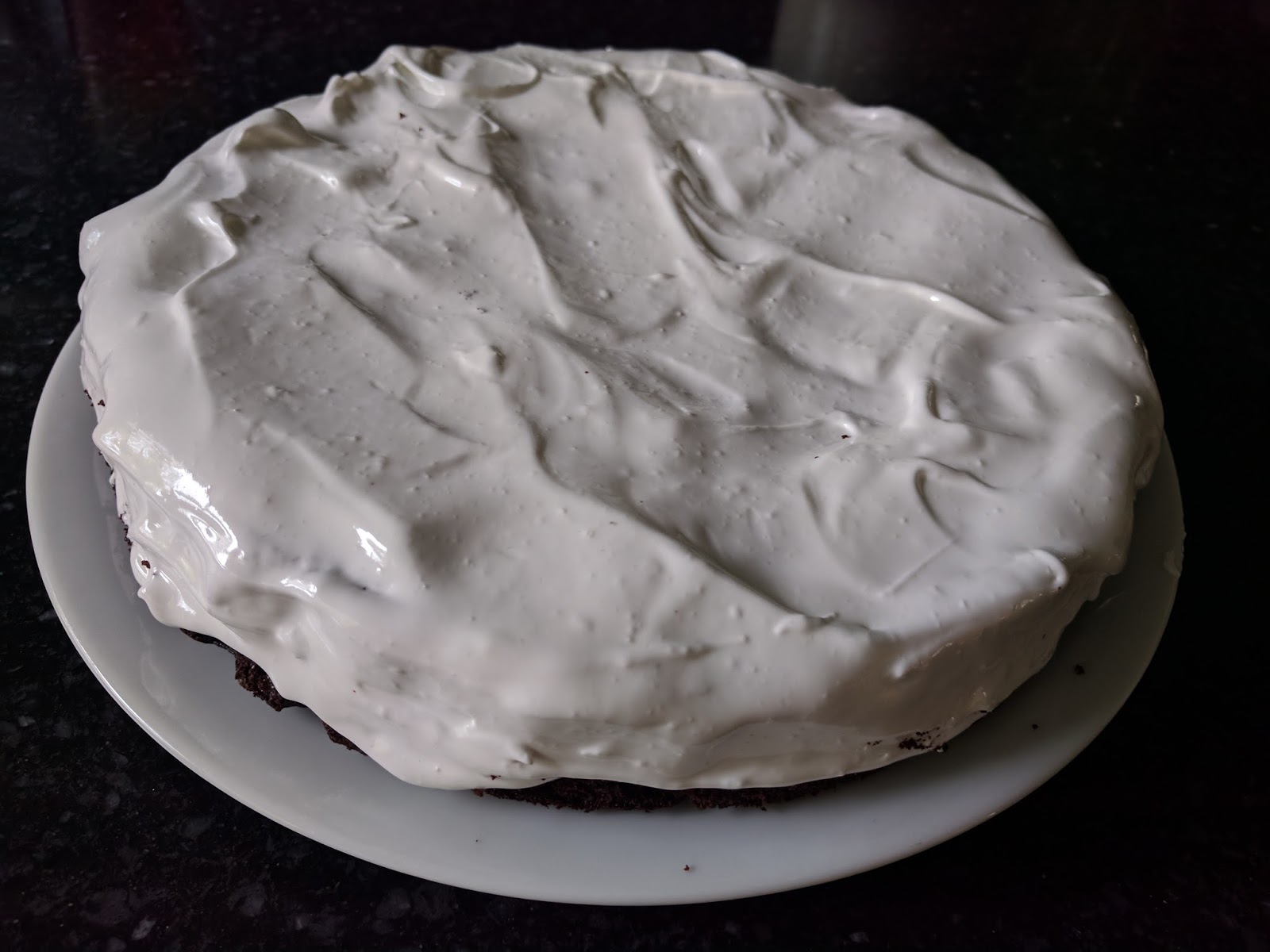 |
| Frosted devil |
So, learning points:
- use the correct size tin as stated
- properly line your tins with baking parchment
- sift your flour before you add it.
Conclusion: the devil's food cake is devilish because it pretends to be a very easy run-of-the-mill cake, but then it tricks you into making all kinds of basic rookie baking mistakes that make your cake come out like a lumpy pancake.
Sunday, 10 September 2017
Apple cake
It is that time of the year; schools have started again, the days are shortening, and Heel Holland Bakt is back on tv. HHB is the Dutch version of The Great British Bake-Off (which has also started again, but on one of the commercial British channels, so I can no longer watch it) and although not as good, it still gets you back into the baking spirit. So that is what I did, last weekend.
I'd made my family's apple cake recipe a while back (in 2014, even!), but this one came from a more distinguished source: Mary Berry herself. If she can't be on Bake-Off anymore, I can at least channel her baking spirit at home!
Ingredients
225 g butter
225 g muscovado sugar
225 g self-raising flour
(I just love this about cakes, just put the same amounts of butter, sugar and flour together, add some eggs, and ta-da: a cake!)
3 eggs (I used 4, but they were really small)
(baking powder)
100 g chopped walnuts
100 g raisins
400 g apples, cut in small pieces (I always keep the peel on, but you can take it off)
1 teaspoon cinnamon
Preheat your oven to 180 degrees.
As ever, mix the butter, sugar, flour and (if you're using it) baking powder together in a bowl. I always mix the 'dry' stuff (flour, sugar and baking powder) together first, before I add the softened butter in small lumps. Then add the eggs, until you get a fairly standard cake mixture. Mix thoroughly for about two minutes. Finally, add the chopped walnuts and raisins, and give it a final mix. I also added some cinnamon at this point, but it's not in the 'official' recipe.
Pour half of the mixture into your prepared (buttered and lined with baking parchment) cake tin. Then pour the apples and cinnamon in a layer on top, spreading it out evenly. Finally, pour the rest of your cake mixture on top. Make sure the edges are made of cake mixture, not apple, or you will have apples poking out of the side of your cake (as I did).
To finish off, sprinkle the top with more walnuts and muscovado sugar. You can leave some lumps in the sugar, but not too big, as it will just give you a mouthful of rock hard sugar when you eat it.
Bake for about an hour and a half, until golden brown and firm (mine was done in an hour and 20 minutes).
Looking good, right? It tasted good, too! Very autumny, with the soft juicy apple and the chopped nuts. If I were to make it again, I'd add some more spices (maybe the 'speculaaskruiden', or just some cardamom and nutmeg), but other than that it was a good start to the baking season!
I'd made my family's apple cake recipe a while back (in 2014, even!), but this one came from a more distinguished source: Mary Berry herself. If she can't be on Bake-Off anymore, I can at least channel her baking spirit at home!
Ingredients
225 g butter
225 g muscovado sugar
225 g self-raising flour
(I just love this about cakes, just put the same amounts of butter, sugar and flour together, add some eggs, and ta-da: a cake!)
3 eggs (I used 4, but they were really small)
(baking powder)
100 g chopped walnuts
100 g raisins
400 g apples, cut in small pieces (I always keep the peel on, but you can take it off)
1 teaspoon cinnamon
Preheat your oven to 180 degrees.
As ever, mix the butter, sugar, flour and (if you're using it) baking powder together in a bowl. I always mix the 'dry' stuff (flour, sugar and baking powder) together first, before I add the softened butter in small lumps. Then add the eggs, until you get a fairly standard cake mixture. Mix thoroughly for about two minutes. Finally, add the chopped walnuts and raisins, and give it a final mix. I also added some cinnamon at this point, but it's not in the 'official' recipe.
Pour half of the mixture into your prepared (buttered and lined with baking parchment) cake tin. Then pour the apples and cinnamon in a layer on top, spreading it out evenly. Finally, pour the rest of your cake mixture on top. Make sure the edges are made of cake mixture, not apple, or you will have apples poking out of the side of your cake (as I did).
To finish off, sprinkle the top with more walnuts and muscovado sugar. You can leave some lumps in the sugar, but not too big, as it will just give you a mouthful of rock hard sugar when you eat it.
Bake for about an hour and a half, until golden brown and firm (mine was done in an hour and 20 minutes).
 |
| Pretty pretty apple cake |
Looking good, right? It tasted good, too! Very autumny, with the soft juicy apple and the chopped nuts. If I were to make it again, I'd add some more spices (maybe the 'speculaaskruiden', or just some cardamom and nutmeg), but other than that it was a good start to the baking season!
Monday, 10 July 2017
Hag-seed
To make good on my promise to myself to read more from certain lovable authors, I ditched the John le Carré novel and started in another Atwood novel; Hag-Seed. Now this is not just any novel; Hogarth is doing a series of Shakespeare-retellings by contemporary authors in contemporary settings, and Hag-Seed was inspired by The Tempest. Or rather, not just inspired by, it is basically the story of The Tempest, including a thwarted theatre director, who aims at getting revenge through staging The Tempest. This sounds very forced, and it probably could have been in the hands of a lesser author, but the novel is actually brilliantly constructed.
Before we get into that, let me get this out of the way; I have never read The Tempest, nor have I ever seen a staging of it. It was one of those 'we won't go there' plays during my studies, and it isn't one of the plays that ever shows up at the local theatre (or not-so-local Shakespeare theatre). There is apparently a film version with Helen Mirren as 'Prospera', but I managed to miss that too.
So, no prior knowledge of the play or the story, although I did read up on the main plotlines and themes on Wikipedia (I found out in the end that there is a short synopsis at the back of the novel, but I'm one of those people who stays very far from the final pages of any novel). Also, the main theme is pretty obvious from the get-go; revenge. The main character, Felix/Prospero, has been thwarted out of his profession as artistic manager of a Shakespeare festival, and now that he has fallen low, he wants his revenge. After an exile of twelve years (not unexpectedly the same amount of time elapses in The Tempest), he finally sees his chance when his former enemies visit the prison in which he now works in a Literacy through Literature programme. It isn't hard to persuade the juvenile delinquents to work with him to get his revenge, and the end result is somewhat disturbing, but also a very entertaining read.
The 'actors' are asked to add their own thoughts, scenes and songs to the play, resulting in some very nice raps (I never thought I would ever write the phrase 'very nice raps'), which gives a triple layer to this retelling (the original play, the novel-as-the-play, and the 'modernized' version they perform). Again, this might have been very forced, but even though you can see what will happen way in advance, the plot never gets in the way of the story. One funny thing that happened was that I kept thinking the play was set in England, and it took about a third of the book to realise it was actually set in the US. Somehow, 'Shakespeare festivals' feel like something Britain-only, and the whole novel oozed Britishness to me. (And then it turns out that Margaret Atwood is actually Canadian, so I have been putting her novels on the wrong shelf of my bookcase for years!)
Anyway, it's a great read, maybe less so if you're not a Shakespeare/theatre geek like me, but even then the whole development of the main character and his young actors will still bring a smile to your face. Amazing, how something that should have been very heavy and deep with Literary Meaning, can still be so very light and pleasant.
Friday, 7 July 2017
The Bridge
The wonderous world of Netflix means that people who otherwise would only watch tv for very special moments (New Year's Eve, The Great British Bake-Off, and Sherlock) can now follow tv series they wouldn't usually be able to fit in their time or daily routine. For me, a great example is The Bridge, a Swedish/Danish series that is now in its third season. This season has been shown on Dutch telivision about half a year ago, but I only found out around episode 4, and there was no 'rewatch' online. But, the first two seasons were on Netflix already, so it was just a matter of waiting until the third would appear too.
Now I am not usually a detective/crime series person. And The Bridge is very detective-y, and with lots of blood splattering around to boot. The first season starts when a dead woman is found on the bridge between Copenhagen and Malmo (this American-made website doesn't let me put accent marks on letters), exactly in the middle, so half of her is in Denmark and the other half in Sweden. As it turns out, she is actually two women; half of her is Danish and the other half Swedish. The image of the two policemen pulling her body apart is one you get in the first ten minutes of the series, and it is just a small example of stuff to come.
What follows, of course, is a search for the killer. Because the bodies were found in both countries, the Swedish and Danish police have to work together. The Danish detective is Martin, a lovable man with an equally sweet wife and couple of kids. The Swedish detective is somewhat less lovable: Saga Noren is a distant, highly analitic, socially awkward stereotype of the mentally unstable detective. Only she isn't unstable. She has come to deal with her personal quirks in a very good way, and her superior, Hans Petterson, knows exactly how good she is, and what he can ask of her. Only Martin, warm and sociable, cannot quite cope with her at first. But inevitably, they become a great duo, and Saga Noren has become somewhat of a cult hero.
So why do I watch The Bridge, and not for example The Killing or Midsummer Night's Murders or Law&Order or CSI (although I did watch that for a while, about ten years ago). Well, partly because it isn't flashy American. They don't have a grainy photo of part of a fingerprint which they then enlarge 100 times to get a perfectly pixel clear image to run through their database to find the killer. They use their brain, they discuss theories around their photoboard, and they talk to a lot of people. Sometimes half of an episode is made up of Saga talking to possible suspects without them actually getting anywhere. But then, three episodes later, a small, seemingly insignificant detail during that conversation will move them in the right direction.
So, it's a social, intellingent series. But on the other hand, it is very modern. It is set in the here and now; they do use modern technology, and people behave in a way normal people would. It isn't the small, isolated world of British villages, this is big cities we're talking about, with homeless people, drug dealers, and all sorts of dark secrets. Added to that, this series isn't afraid to kill off it's main characters, so the fear you feel when people start shooting is genuine. This puts it smartly between the sleepy British detectives and the flasy American ones, in the middle of the real world.
I've just finished watching season 3, which I won't tell you too much about as it would inevitably contain spoilers. The overall theme though, is 'family', which is quite unusual for a detective (we generally get a bit of the detective's family life just to know why they are so distant/cold/tired/depressed, but not more than that), and it introduces a couple of great new characters which I have come to love. They're already busy developing season 4, so I hope we will see more of them, then.
The only downside is that there are only 10 episodes per season (still a lot more than in a regular Sherlock season, but still). Although, as they say, less tends to be more.
Subscribe to:
Posts (Atom)